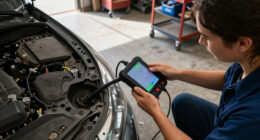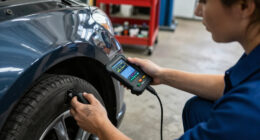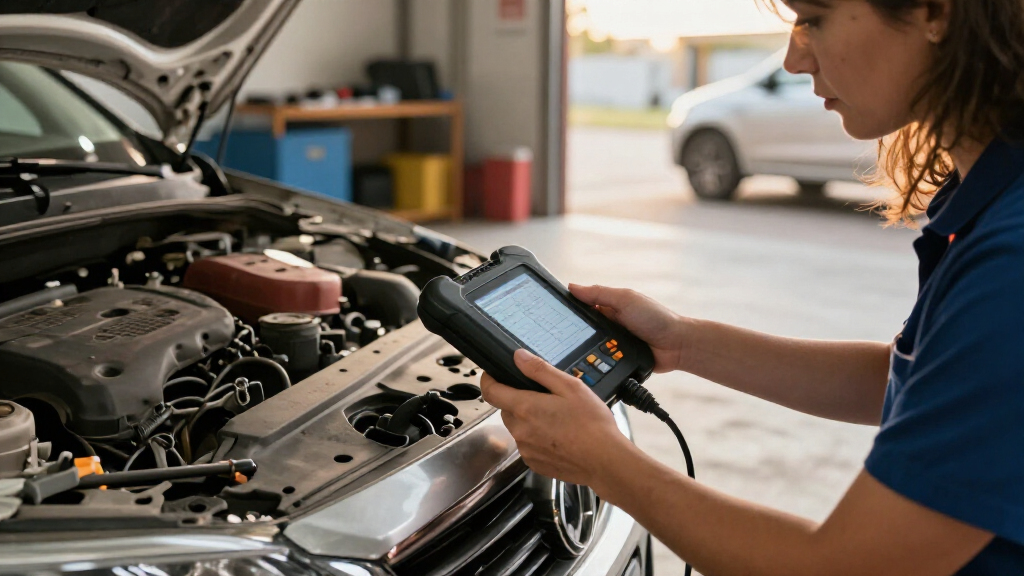

When a warning light appears, the choice is often between a low-cost OBD2 code reader and a more capable professional diagnostic scanner. Both can help identify a fault, but they answer different questions. A basic reader is designed to retrieve standard engine and emissions codes; a professional tool may communicate with systems such as ABS, airbags and transmission, and may let the user command supported components or perform service procedures.

Get business pricing on garage and car supplies
- Business-only prices and quantity discounts
- Tax-exempt purchasing
- Multiple users, one account, clear invoices

FOXWELL NT301 OBD2 Scanner with Live Data
- ✔ Brand and model: FOXWELL NT301
- ✔ Screen: 2.8-inch color screen
- ✔ Functions: Engine codes, live data, I/M readiness

ANCEL AD410 OBD2 Vehicle Code Reader
- ✔ Brand and model: ANCEL AD410
- ✔ Display: 2.4-inch color display
- ✔ Functions: Codes, live data, freeze frame, readiness, O2 and EVAP tests

ANCEL AD310 OBD II Scanner and Engine Code Reader
- ✔ Brand and model: ANCEL AD310
- ✔ Interface: OBD II
- ✔ Functions: Read and clear codes, live data, freeze frame, I/M readiness
That difference matters more than the label on the box. A driver who wants to check a check-engine light before booking a repair may get what they need from a basic reader. Someone diagnosing recurring faults, maintaining several vehicles or working on their own repairs may benefit from broader access. Professional scanners cost more, and their advertised functions depend on vehicle make, model, year and software coverage, so paying extra makes sense only when the additional capabilities match the work.
At a Glance
| Criteria | Basic OBD2 code readers | Professional bidirectional diagnostic scanners | Winner |
|---|---|---|---|
| Typical price | Usually low-cost | Higher purchase price; some features may require subscriptions | A |
| System coverage | Primarily standard OBD2 engine and emissions systems | Can cover multiple modules, depending on vehicle and tool | B |
| Fault-code detail | Reads and may clear standard powertrain codes; descriptions vary | Often provides module-specific codes and expanded descriptions | B |
| Live data | Basic engine sensor readings on supported vehicles | More parameters and display options on supported systems | B |
| Active tests and service functions | Generally absent or limited | May support bidirectional tests and service resets on listed vehicles | B |
| Ease of use | Simple handheld operation | More menus and setup; learning curve varies | A |
| Vehicle and software coverage | Standard OBD2 support; enhanced functions vary by device | Coverage and functions vary by vehicle, software and updates | Depends |
| Best fit | Occasional check-engine-light checks | Frequent diagnostics, DIY repairs or workshop use | Depends |
FOXWELL NT301 OBD2 Scanner with Live Data
The FOXWELL NT301 earns the top spot because it does more than return a code: it helps us watch sensor readings as the engine runs. Its live data graphs and logging can make changing values easier to follow than a plain numerical display, which is useful when we are comparing behavior over time or preparing clear information for a mechanic. The I/M readiness hotkeys, red-yellow-green LED and speaker add quick feedback for emissions checks.Compared with the ANCEL AD410, the NT301 puts more emphasis on graphing and status cues, while the AD410 offers on-screen code definitions and multilingual support. The AD310 is simpler still, making it reasonable for basic code checks but less capable as a live-data companion. The NT301 remains an engine and emissions reader: it does not scan ABS, SRS or TPMS, perform service resets, or offer manufacturer-specific full-system coverage. EVAP tests and other functions also depend on the vehicle. We should choose it for better visibility into engine readings, not as a complete workshop tool.
Pros:
- Displays and logs live sensor data in graphs
- Readiness hotkeys with a color LED indicator and speaker
- 2.8-inch color screen is designed for clear viewing
- Powered through the diagnostic port without an internal battery
Cons:
- Does not diagnose ABS, SRS or TPMS systems
- Does not provide service resets or key programming
- Available functions and EVAP testing vary by vehicle
Best for: Drivers who want to monitor and log live engine sensor data and check emissions readiness at home.
Not ideal for: Owners who need ABS, airbag, TPMS or transmission scans, service resets, or full-system manufacturer-specific diagnostics.
Bottom line: We recommend the NT301 when following live engine data matters more than getting on-screen code definitions or broader system coverage.
“We recommend the NT301 when following live engine data matters more than getting on-screen code definitions or broader system coverage.”
ANCEL AD410 OBD2 Vehicle Code Reader
The ANCEL AD410 is the friendliest pick for a driver who wants to understand a code without first looking it up elsewhere. Its 2.4-inch color display and on-screen code definitions reduce friction during a quick check, and the feature set includes live data, freeze-frame information, I/M readiness, O2 sensor and EVAP tests, vehicle information, and MIL status. That breadth makes it a useful step up from the more stripped-down feel of the AD310.Compared with the FOXWELL NT301, the AD410 offers code definitions and multilingual support, while the NT301 is better suited to watching and logging live values in graphs. The choice depends on whether we want more explanation at the screen or stronger visual tracking of sensor behavior. The AD410 still reads engine and emissions information only; it cannot handle ABS, SRS, transmission, bidirectional controls or service resets. A definition can orient us, but it cannot confirm the cause of a fault. We should treat it as a more approachable code reader, not a repair prescription.
Pros:
- On-screen code definitions and multilingual support
- Color display presents diagnostic information clearly
- Includes live data, freeze frame and I/M readiness
- Runs from the vehicle port and has free software updates
Cons:
- Limited to engine and emissions-related diagnostics
- No ABS, SRS, transmission, bidirectional or service reset functions
- Vehicle compatibility and test availability vary
Best for: Newer DIY users who want a color display, code definitions and several common emissions checks in one handheld tool.
Not ideal for: Drivers who need graph-focused live data, service functions, bidirectional controls or diagnostics beyond engine and emissions systems.
Bottom line: We would choose the AD410 when accessible code explanations and a broad set of basic emissions checks are the priority.
“We would choose the AD410 when accessible code explanations and a broad set of basic emissions checks are the priority.”
ANCEL AD310 OBD II Scanner and Engine Code Reader
The ANCEL AD310 is the uncomplicated choice for reading and clearing emission-related trouble codes, checking I/M readiness, and reviewing live or freeze-frame data. It supports multiple common OBDII protocols and draws power from the vehicle, so there is no battery or charger to manage. Its 2.5-foot insulated cable gives a little room to position the handheld unit while connected, a practical detail for a basic scan under the dash.Against the AD410, the AD310 gives up the color screen and on-screen definitions, so we may need another source to interpret unfamiliar codes. It also lacks the NT301’s graphing and data logging, making it less suited to tracking sensor changes. Its appeal is narrow by design: the core engine and emissions checks without extra presentation features. That also defines the limitation. It does not cover OBD I, ABS, SRS or transmission diagnostics, and its displayed code is a starting point rather than proof of a failed part. We would pick it when simple code access is enough and skip it when interpretation support matters.
Pros:
- Reads and clears emission-related trouble codes
- Shows live data, freeze-frame details and I/M readiness
- Flexible, insulated 2.5-foot cable
- Compact, vehicle-powered design needs no separate battery
Cons:
- Limited to emission-related diagnostics
- Does not support OBD I vehicles
- No ABS, SRS or transmission diagnostics
Best for: Drivers who need a straightforward handheld reader for engine or emissions codes and readiness checks on a compatible OBD2 vehicle.
Not ideal for: Buyers who want on-screen code definitions, graphing, advanced service functions, or scans of ABS, SRS and transmission systems.
Bottom line: We suggest the AD310 for basic OBD2 checks when a simple display and essential functions matter more than guided interpretation.
“We suggest the AD310 for basic OBD2 checks when a simple display and essential functions matter more than guided interpretation.”
As an Amazon Associate we earn from qualifying purchases.
Key Differences
The biggest difference is the depth of access. A basic code reader is useful for a common first question: what standard engine fault code is stored? It can help a driver see whether a check-engine light relates to a sensor, misfire or emissions issue, and can provide a starting point for a repair conversation. It does not prove which part has failed. Codes describe detected conditions, and diagnosis still requires checking symptoms, wiring, connections and test results.
A professional scanner can reach further when the fault sits outside the engine computer or when a code alone is not enough. Depending on the vehicle and tool, it may read other modules, show expanded data, or perform active tests and service resets. These functions can save time for a capable user, but support is not universal. Two scanners with similar claims may cover different makes or model years, and a function listed for one vehicle may not be available on another.
The practical tradeoff is cost and complexity against capability. For an occasional code check on one car, a basic reader is usually better value. For repeated repairs, multiple vehicles or faults involving several systems, a professional scanner may pay off through broader information and control. Buyers should verify exact vehicle coverage and the functions they need before paying for a premium device.
Detailed Comparison
System coverage (Professional bidirectional diagnostic scanners wins — major)
Basic OBD2 readers focus on standard powertrain and emissions diagnostics. Professional scanners often access additional modules such as ABS, airbag and transmission systems, when supported by the vehicle. Professional scanners win by a major margin for multi-system faults: a driver investigating an airbag warning, for example, may need access a basic reader cannot provide. Coverage still varies by model, so check the tool’s compatibility list.
Code detail and diagnosis (Professional bidirectional diagnostic scanners wins — moderate)
A basic reader can retrieve useful standard codes, but the amount of explanation varies and the code itself is not a diagnosis. A professional scanner may show manufacturer-specific codes or module data that narrows the search. B wins by a moderate margin for deeper troubleshooting, especially on vehicles with several electronic systems. A remains sufficient when the goal is simply to learn what standard powertrain code is stored.
Live data (Professional bidirectional diagnostic scanners wins — moderate)
Both categories may display live engine readings, but professional scanners commonly offer more data points, graphing or access to readings from additional modules. B wins by a moderate margin for users who can interpret the information and use it to test a suspected cause. For a quick check rather than hands-on diagnosis, the extra screens may add little practical value.
Active tests and service functions (Professional bidirectional diagnostic scanners wins — major)
A basic reader generally reads or clears codes and does not command vehicle components. Some professional scanners support bidirectional tests, resets or maintenance procedures, but availability depends on the vehicle and tool. B wins by a major margin when a supported test or service function is part of the planned repair. If the user only wants to read a warning light, these features do not justify a higher price.
Price and value (major difference)
Basic readers are typically far less expensive, making them a sensible purchase for occasional checks. Professional scanners cost more and may carry subscription or update charges. A wins for one-car, low-frequency use; B can be better value for a repair hobbyist or shop that uses its broader functions regularly. Paying more is worthwhile only if specific supported features will be used.
Ease of use (Basic OBD2 code readers wins — moderate)
A basic reader usually has a shorter setup and simpler menus. Professional tools can require more navigation, software updates and familiarity with diagnostic terms. A wins by a moderate margin for a first-time user who wants a quick code lookup. A simpler interface does not make the reader more accurate, but it can make routine checks less intimidating.
Vehicle coverage and updates (moderate difference)
Basic readers rely mainly on standard OBD2 compatibility, while advanced functions on either category can vary by make, year and model. Professional scanners may advertise broad coverage, yet specific modules and service operations still need verification. There is no universal winner: compare the exact vehicle list, supported functions and update terms before purchase. This check can matter more than the device’s headline feature count.
Basic OBD2 code readers: Pros and Cons
Pros:
- Low purchase cost for occasional use
- Simple operation and quick access to standard engine codes
- Useful starting point before discussing a check-engine light with a mechanic
Cons:
- Usually limited to standard powertrain and emissions diagnostics
- Does not identify the failed part by itself
- Typically lacks active tests and broader service functions
Professional bidirectional diagnostic scanners: Pros and Cons
Pros:
- Can access additional vehicle modules when supported
- Often offers more detailed codes and live data
- May run active tests or service procedures on compatible vehicles
Cons:
- Higher cost, with possible ongoing software charges
- More complex menus and diagnostic information
- Feature and module support varies by vehicle and scanner
Who Should Choose What
Choose Basic OBD2 code readers if:
- You want to check an occasional check-engine light on a single car.
- You mainly need standard engine codes to guide a conversation with a repair shop.
- You want a low-cost tool and do not plan to run repairs or service procedures.
Choose Professional bidirectional diagnostic scanners if:
- You diagnose or repair vehicles regularly and will use the broader features.
- You need access to modules such as ABS or airbags on a specifically supported vehicle.
- You want live data, active tests or service functions and have confirmed the scanner supports your car.
Skip both if: Skip both if you need a confirmed repair diagnosis but do not have the tools or experience to interpret the results; use the codes as background and consult a qualified technician.
Value for Money
For most drivers who only want to identify a standard check-engine code once in a while, a basic reader is the better value. It costs less and handles the narrow task without asking the buyer to pay for features that may sit unused. Treat its result as a clue, not a repair order: replacing a part based only on a code can waste money.
Pay more for a professional scanner when its added coverage solves a recurring need. A DIY mechanic maintaining several vehicles, or a technician using active tests and module access frequently, can get practical value from the extra capability. Before buying, confirm the exact vehicle compatibility, required functions, update policy and any subscription cost. A high feature count has little value if the scanner cannot perform the specific job on the buyer’s car.
Final Verdict
Choose a basic OBD2 reader if your need is an occasional standard engine-code check; it is the clearest value for most everyday drivers. Choose a professional bidirectional scanner if you regularly diagnose faults, work across multiple modules or need supported active tests and service functions. The deciding factor is whether broader vehicle access will be used often enough to justify the higher cost. Verify your exact car’s coverage before buying either tool.
Frequently Asked Questions
Can a basic OBD2 reader diagnose why the check-engine light is on?
It can retrieve a standard code that points toward the detected condition, but the code alone does not confirm which component failed. Further checks may be needed to identify the cause.
Will a professional scanner work with every car?
No. Standard OBD2 functions and advanced module access differ. Check the scanner’s compatibility information for the vehicle’s make, model and year, along with the exact functions you need.
Is a bidirectional scanner worth the extra cost for home use?
It can be if you regularly perform repairs that use active tests or supported service functions. For occasional code reading, a basic reader is usually better value.
Should I clear a code after reading it?
Clearing a code can remove useful diagnostic information and may turn off a warning temporarily without fixing the underlying fault. Record the code first and address the cause before clearing it.