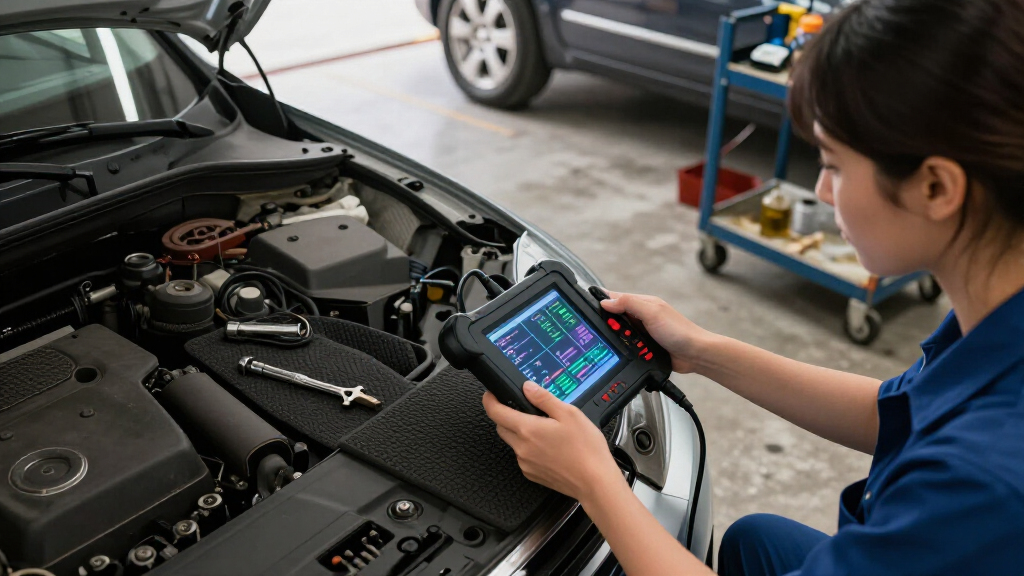

When a warning light appears, a Bluetooth OBD-II scanner and a handheld car diagnostic scanner can both help identify what the car’s computer has reported. The decision is about how much capability and independence you need: Bluetooth models rely on a compatible phone and app, while handheld units have their own display and controls and may include features beyond basic emissions diagnostics.

Get business pricing on garage and car supplies
- Business-only prices and quantity discounts
- Tax-exempt purchasing
- Multiple users, one account, clear invoices

FOXWELL NT301 OBD2 Scanner Live Data Professional Mechanic OBDII Diagnostic Code Reader Tool for Check Engine Light
- ✔ Screen: 2.8-inch color display
- ✔ Diagnostic functions: Read and clear engine codes, live data graphing and logging, EVAP and oxygen sensor tests
- ✔ Readiness: Dedicated I/M readiness controls with red-yellow-green indicator

ANCEL AD310 Classic Enhanced Universal OBD II Scanner Car Engine Fault Code Reader
- ✔ Diagnostic functions: Read and clear codes, freeze-frame data, I/M readiness and live data
- ✔ Protocols: KWP2000, J1850 VPW, ISO9141, J1850 PWM and CAN
- ✔ Vehicle coverage: 1996+ US-based and 2000+ European and Asian cars, light trucks and SUVs

V318 OBD2 Scanner Diagnostic Tool, Car Engine Code Reader with Battery Voltage Test, Read & Clear Codes, DTC Lookup, Live Data, I…
- ✔ Diagnostic functions: Read and clear codes, DTC lookup, live data, freeze frames and I/M readiness
- ✔ Additional check: Battery voltage reading
- ✔ Vehicle coverage: Many 12V OBDII/EOBD gasoline vehicles; verify compatibility
For occasional checks and a tight budget, a Bluetooth scanner is often the sensible first buy. A handheld unit makes more sense for drivers who want a device ready without an app, or for people who regularly diagnose multiple vehicles and need functions such as service resets or access to additional control modules. Features vary widely by model and vehicle, so a higher price alone does not guarantee broader coverage.
At a Glance
| Criteria | Bluetooth OBD-II scanner | Handheld car diagnostic scanner | Winner |
|---|---|---|---|
| Upfront cost | Usually the lower-cost entry point; some apps are free, while others charge for extra features. | Usually costs more, particularly for models with broader vehicle coverage or service functions. | A |
| Setup and ease of use | Requires a compatible phone, app installation, pairing, and sometimes account setup. | Self-contained screen and controls; generally ready to use without a phone app. | B |
| Basic engine and emissions codes | Typically reads and clears standard OBD-II powertrain codes when supported by the vehicle. | Usually handles standard OBD-II engine codes, though code explanations and tools vary. | Tie |
| Live data and app features | Can offer customizable dashboards, logging, graphs, and sharing; options depend on the app. | Often provides simpler built-in readings; some models have limited logging or updates. | Depends |
| Advanced system coverage | Often limited unless the adapter and app explicitly support manufacturer-specific systems. | Some models access ABS, airbag, transmission, or service functions on selected vehicles. | B |
| Portability and independence | Small and easy to leave in the car, but depends on a charged, compatible phone. | Works without a phone, but is larger than a small Bluetooth adapter. | B |
| Ongoing costs and compatibility | Check phone support, app fees, adapter quality, and vehicle compatibility before buying. | May require paid updates or have coverage limits; confirm supported makes, years, and functions. | Depends |
FOXWELL NT301 OBD2 Scanner Live Data Professional Mechanic OBDII Diagnostic Code Reader Tool for Check Engine Light
The FOXWELL NT301 is the most capable engine-focused pick in this group because it goes beyond reading and clearing codes. Its live data graphing and logging can help us watch values such as coolant temperature, RPM, oxygen sensor readings and fuel trims, which gives a more useful picture when a fault is intermittent or a code needs context. It also lists EVAP and oxygen sensor tests, plus an I/M readiness indicator for a quick emissions inspection check.Compared with the ANCEL AD310, the NT301 offers more ways to investigate a problem rather than just retrieve the code and basic data. Its color display, dedicated readiness controls and LED status indicator also give it a more guided feel. The tradeoff is that added functions do not make it a whole-car scanner: its described scope is still OBDII engine and emissions diagnostics, with no listed ABS, SRS or transmission coverage. Buyers should also verify which tests their particular vehicle supports.Against the V318, the NT301’s clearest advantage is its specified graphing and logging, while the V318 supplies a battery voltage readout and code definitions on the device. The NT301 description does not list a battery test or built-in code lookup, and it is more tool-like than a bare-bones reader. We would choose it when interpreting engine behavior matters more than having the fewest controls. Its claimed lifetime updates and seller assurance are listing details; they do not change the scanner’s vehicle-system limits.
Pros:
- Graphs and logs live engine data for closer troubleshooting.
- Lists EVAP and oxygen sensor tests alongside code reading and clearing.
- Dedicated I/M readiness controls and a clear LED status indicator.
- 2.8-inch color screen and support for several common OBDII protocols.
Cons:
- The documented diagnostic scope centers on OBDII engine and emissions systems.
- Feature availability can vary by vehicle; compatibility should be confirmed before purchase.
- No battery voltage test or built-in DTC definition lookup is specified.
Best for: DIY owners who want to examine live engine sensor behavior and check emissions readiness before or after a repair.
Not ideal for: Drivers seeking ABS, airbag, transmission or other manufacturer-specific module diagnostics, or a scanner whose primary advantage is battery testing.
Bottom line: Choose the FOXWELL NT301 when live engine data and emissions checks matter more than the AD310’s simplicity or the V318’s battery reading.
“Choose the FOXWELL NT301 when live engine data and emissions checks matter more than the AD310’s simplicity or the V318’s battery reading.”
ANCEL AD310 Classic Enhanced Universal OBD II Scanner Car Engine Fault Code Reader
For a driver who wants a direct answer to “what engine code is stored?”, the ANCEL AD310 keeps the process uncomplicated. It reads and clears trouble codes, shows freeze-frame information, checks I/M readiness and displays live data. Because it takes power from the car’s OBDII port, there is no separate battery or charger to keep ready. Its clearly labeled buttons and large screen suit occasional checks without requiring a more elaborate menu of tests.The AD310 comes second because its basic coverage is broad on paper—it lists all five common OBDII protocols and model-year guidance for US, European and Asian vehicles—but it offers less analysis than the FOXWELL NT301. The FOXWELL’s graphing, logging and specified EVAP and oxygen sensor tests make it better suited to following up on a code. If we mainly need to identify a check engine fault or confirm readiness, those extra capabilities may not be necessary; if we want to inspect changing sensor values, the AD310 is the more limited tool.Compared with the V318, the AD310’s advantage is its explicit protocol list and wide stated year and region coverage. The V318, in turn, lists an on-device DTC lookup and battery voltage check—two conveniences not specified for the ANCEL. Its key limitation is important: it handles emissions-related OBDII diagnostics, not ABS, SRS or transmission systems, and it will not work with OBDI vehicles through an adapter. Choose it for straightforward engine checks, not broader fault tracing.
Pros:
- Reads and clears codes, displays freeze frames and checks I/M readiness.
- Lists support for five common OBDII protocols.
- Broad stated coverage by model year and vehicle region.
- Vehicle-powered design and plainly labeled buttons.
Cons:
- Limited to emissions-related OBDII diagnostics.
- No ABS, SRS or transmission diagnostics are listed.
- Does not support OBDI vehicles, even when used with an adapter.
Best for: Owners who want an uncomplicated, corded reader for engine codes, freeze-frame information and emissions readiness on a supported OBDII vehicle.
Not ideal for: Anyone who needs ABS, SRS, transmission, OBDI or deeper live-data analysis.
Bottom line: Pick the ANCEL AD310 for dependable basic OBDII checks when simplicity and broad stated protocol support matter more than advanced data tools.
“Pick the ANCEL AD310 for dependable basic OBDII checks when simplicity and broad stated protocol support matter more than advanced data tools.”
V318 OBD2 Scanner Diagnostic Tool, Car Engine Code Reader with Battery Voltage Test, Read & Clear Codes, DTC Lookup, Live Data, I…
The V318 brings together practical basics that are split across the other picks: code reading and clearing, live data, freeze frames, I/M readiness, an on-device DTC lookup and a battery voltage reading. That last function makes it useful for a quick battery status check as part of routine ownership, while the built-in code definitions can save us from immediately reaching for a separate reference. Its color screen and simple button layout are aimed at home users and basic workshop checks.Those features place it between the ANCEL AD310 and FOXWELL NT301 in everyday use, but not in a simple performance ranking. The AD310 has more explicit protocol and regional coverage information; the V318’s listing says it suits many 12V gasoline OBDII/EOBD vehicles, so buyers have less detail to match against a particular car. The FOXWELL is the stronger choice when graphing and logging live sensor data or performing listed EVAP and oxygen sensor tests is a priority. The V318’s description mentions live data but does not specify graphing.We rank the V318 third because its listed feature set is appealing but its coverage details are less precise than the other two, and several specifications—including supported protocols—are not supplied. It is also not described as a full-system tool, so we should not assume it can inspect ABS, SRS or transmission faults. For a compatible gasoline vehicle, the combination of voltage testing and code lookup is convenient; for a buyer who values clearer compatibility guidance or more detailed engine analysis, the other picks make a stronger case.
Pros:
- Reads and clears codes and includes on-device DTC definitions.
- Adds a battery voltage reading for routine checks.
- Shows live data, freeze frames and I/M readiness.
- Compact handheld design with a color display and no separate charging requirement.
Cons:
- Compatibility is described broadly for many 12V gasoline OBDII/EOBD vehicles, with no protocol list supplied.
- Live data graphing and logging are not specified.
- No ABS, SRS or transmission diagnostics are listed.
Best for: Home users with a supported 12V gasoline OBDII/EOBD vehicle who want code definitions and a quick battery voltage reading in one handheld tool.
Not ideal for: Owners who need clearly documented protocol coverage, advanced graphing, diesel coverage confirmation, or diagnostics beyond the engine OBDII functions described.
Bottom line: Choose the V318 if its built-in code lookup and voltage check suit your routine, after confirming that your specific gasoline vehicle is supported.
“Choose the V318 if its built-in code lookup and voltage check suit your routine, after confirming that your specific gasoline vehicle is supported.”
As an Amazon Associate we earn from qualifying purchases.
Key Differences
The largest practical difference is the diagnostic boundary. Both types can be useful for standard OBD-II engine and emissions trouble codes, but neither should be assumed to diagnose every warning light or repair a fault. Bluetooth performance depends on the adapter and app together. Handheld scanners also vary: some stay focused on basic engine codes, while higher-tier models add access to more vehicle systems or service procedures. Check exact vehicle and function coverage before treating those features as a reason to pay more.
Bluetooth is usually the better value for occasional use because a phone can present data in flexible charts and logs at a lower starting cost. Its tradeoff is setup and reliance on an app. A handheld scanner costs more but is simpler to pick up and use without a phone, and selected models can offer broader functions. For a driver who only wants to understand a check-engine light, that extra capability may go unused; for a hands-on owner or small repair operation, it can justify the premium.
Detailed Comparison
Upfront cost (Bluetooth OBD-II scanner wins — moderate)
Bluetooth wins, usually by a moderate margin. Basic adapters are often inexpensive, although a useful app may add a purchase or subscription cost. A handheld scanner has a higher initial price, especially when it includes system-specific diagnostics. For a one-time code check, the cheaper adapter is generally better value; frequent users should compare total costs, including app access and updates.
Setup and ease of use (Handheld car diagnostic scanner wins — minor)
Handheld wins by a minor to moderate margin for ready-to-use simplicity. It has a built-in screen and controls, so there is no app to install or Bluetooth pairing to manage. Bluetooth remains straightforward for anyone comfortable using phone apps, but setup can vary across adapters and software. Choose the handheld if you want a dedicated tool that works independently of your phone.
Basic engine and emissions codes (minor difference)
This is close to a tie. Both types commonly support standard OBD-II powertrain codes on compatible vehicles. The bigger differences are how clearly each model explains a code and what data it can display, rather than its form factor. Neither format can confirm a repair from a code alone; symptoms and proper diagnosis still matter.
Live data and app features (Bluetooth OBD-II scanner wins — moderate)
Bluetooth often wins for flexibility, but the result depends on the app. Phone software may provide configurable gauges, charts, trip logs, and ways to save or share readings. A handheld can show live data too, though simpler models may have fewer ways to view or record it. This gap is minor for checking a single reading and moderate for someone who wants to compare data over time.
Advanced system coverage (Handheld car diagnostic scanner wins — major)
Handheld wins when the model explicitly supports the needed system. Some units can communicate with ABS, airbag, or transmission modules, or perform selected service resets. Many budget handheld scanners cannot, and some Bluetooth setups offer advanced features through compatible apps. Since coverage is vehicle-specific, this is a major difference only when you need a listed function; verify make, model, year, and procedure first.
Portability and independence (Handheld car diagnostic scanner wins — minor)
Handheld wins for independent operation; Bluetooth wins for storage. A handheld scanner is ready without a phone, which is useful in a shared garage or when the phone battery is low. A Bluetooth adapter is smaller and easier to keep in a glovebox. The practical winner depends on whether compact storage or phone-free operation matters more.
Ongoing costs and compatibility (moderate difference)
There is no universal winner. Bluetooth buyers need to check app pricing, operating-system support, and adapter compatibility. Handheld buyers should check update fees, supported vehicles, and whether advertised functions apply to their car. The risk in both cases is paying for a feature that does not work with the specific vehicle, so coverage details matter more than the category name.
Bluetooth OBD-II scanner: Pros and Cons
Pros:
- Usually affordable for basic code reading.
- Phone apps can offer flexible live-data displays and logging.
- Compact adapter is easy to store.
Cons:
- Needs a compatible phone and app.
- App quality, features, and fees vary.
- Advanced vehicle-system access is not guaranteed.
Handheld car diagnostic scanner: Pros and Cons
Pros:
- Operates with its own screen and controls.
- No phone pairing or app setup is needed for basic use.
- Some models support additional modules and service functions.
Cons:
- Costs more, especially for broader coverage.
- Larger than a small adapter.
- Capabilities and update terms vary by model and vehicle.
Who Should Choose What
Choose Bluetooth OBD-II scanner if:
- You mainly want to read a check-engine code at low cost.
- You already use your phone for vehicle data and do not mind installing an app.
- You want charts or logs and have verified that the app supports your car.
Choose Handheld car diagnostic scanner if:
- You want a dedicated scanner that works without a phone.
- You diagnose vehicles often and can use the handheld’s specific supported functions.
- You have verified that its advertised ABS, airbag, transmission, or service features cover your vehicle.
Skip both if: You need a confirmed repair diagnosis, advanced programming, or safety-critical work beyond the scanner’s documented coverage; consult a qualified mechanic or use a professional tool suited to the vehicle.
Value for Money
For an owner who checks an engine light occasionally, paying more for a handheld is usually not worthwhile unless its screen-free-from-phone operation or a listed extra function solves a real need. A low-cost Bluetooth adapter paired with a suitable app can cover basic code reading and provide useful live data. For frequent diagnostics, a handheld may be better value if it reliably supports the vehicles and functions you work with. Compare the full cost, including app subscriptions or scanner updates, and confirm coverage before purchase.
Final Verdict
Most drivers who want to understand a standard check-engine light should start with a reputable Bluetooth OBD-II scanner and a compatible app. It costs less and can provide capable code reading and live data. Choose a handheld scanner if you value phone-free operation or need a specific advanced function that the model explicitly supports for your vehicle. The deciding factor is not the screen: it is whether you need only standard engine codes or verified access to additional systems.
Frequently Asked Questions
Can both scanner types read a check-engine light code?
Generally, yes, when the vehicle and scanner support standard OBD-II diagnostics. Both can report codes, but a code points to a detected condition and does not, by itself, identify the failed part or prove that a repair is needed.
Does a handheld scanner always diagnose more than a Bluetooth adapter?
No. Some handheld units only cover basic engine codes. Broader access depends on the exact scanner, vehicle, and supported functions. Check the manufacturer’s compatibility information before buying.
Do Bluetooth scanners need an internet connection?
Bluetooth links the adapter to the phone; internet access is not inherently required to read vehicle data. An app may need internet for downloads, account features, code lookups, or updates, so check its requirements.
Is the higher price of a handheld scanner worth it?
It can be worth paying more if you use it regularly, want a dedicated screen, or need confirmed access to extra systems or service functions. For occasional standard engine-code checks, a Bluetooth setup is usually the stronger value.
Fall Picks
fall essentials
As an affiliate, we earn on qualifying purchases.