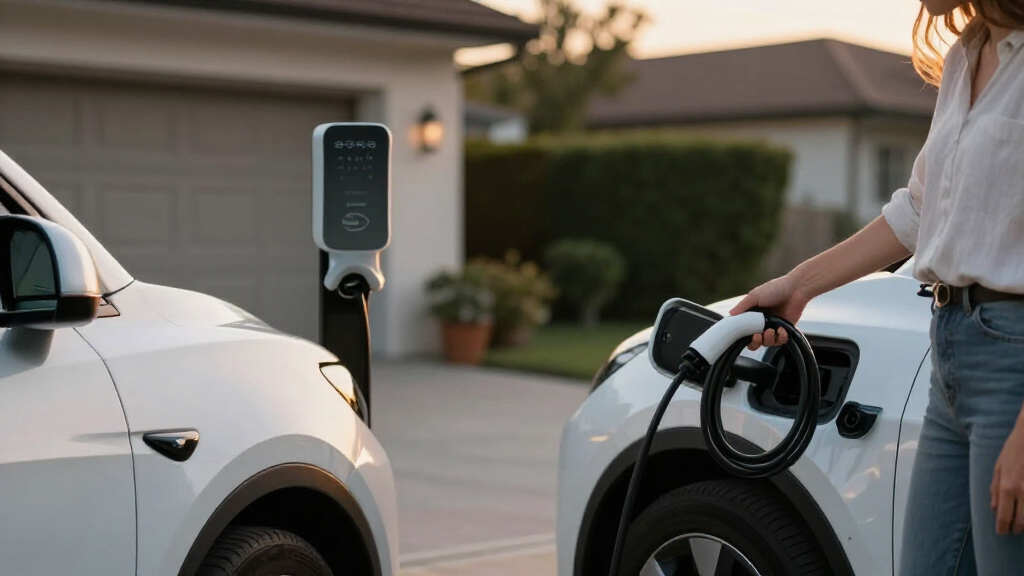

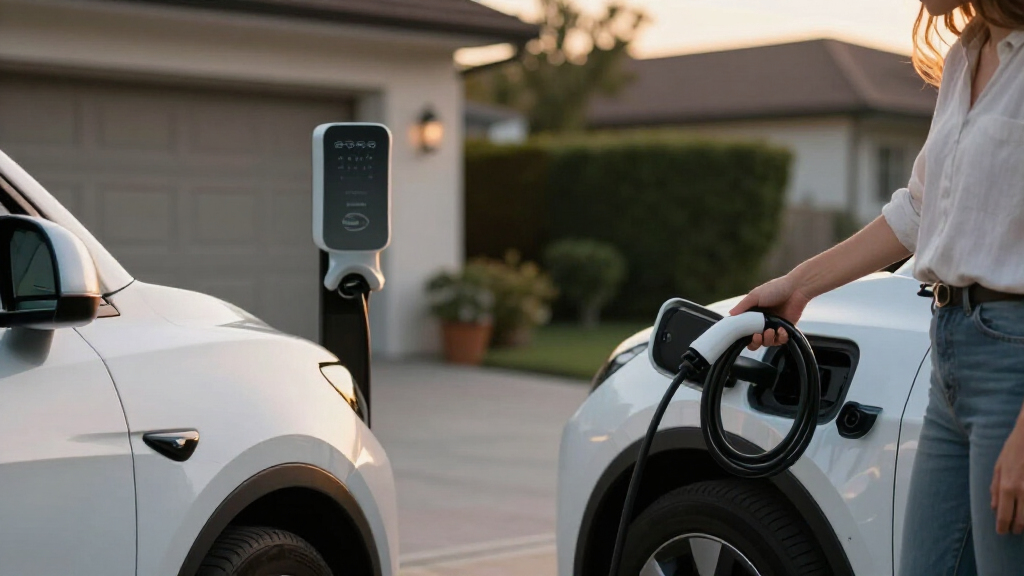
The best electric car charger for most homeowners is the Emporia Level 2, which pairs 48-amp charging with Wi-Fi features and a plug-in option for compatible outlets. The EVIQO 48A hardwired model suits drivers who want a dedicated high-output installation, while the 16A adjustable Level 1/Level 2 charger offers flexibility for lower-power setups. The main tradeoffs are charging speed, plug-in convenience versus hardwiring, and whether smart controls justify extra setup. Your car and home wiring may limit the power you can use, regardless of the charger’s rating. Read on for the full comparison and guidance on choosing a charger that fits your daily driving and electrical setup.

Get business pricing on garage and car supplies
- Business-only prices and quantity discounts
- Tax-exempt purchasing
- Multiple users, one account, clear invoices
Complete the kit



Key Takeaways
- Emporia is the most balanced pick in this lineup: it combines 48-amp capability, Wi-Fi, and a NEMA 14-50 plug, but the outlet and circuit must support the load.
- Hardwired chargers lead when a dedicated installation is practical: EVIQO’s 48A model, the 48A 11.5 kW charger, and ELEGRP trade plug-in flexibility for a fixed setup.
- Portable plug-in models cover different power needs: EVDANCE’s 32A version favors moderate output, while its 40A version offers more headroom on a suitable circuit.
- Smart features vary more than the J1772 connector: Emporia and AIMILER list Wi-Fi controls, while several other options focus on straightforward charging.
- Connector planning matters for future-proofing: most picks use J1772, while ApexCharger MACH 1 includes a Tesla NACS adapter; buyers still need to confirm vehicle and adapter compatibility.




| electric car charger | Connector | Cable length | Voltage | Maximum current |
|---|---|---|---|---|
| 16A Adjustable Level 1 and Lev | SAE J1772 | 25 ft | 110V–240V | — |
| EVIQO Level 2 J1772 48A Hardwi | J1772 | 25 ft | — | — |
| EVDANCE Level 2 EV Charger | SAE J1772 | 25 ft | — | 32A; adjustable to 10A, 16A, 20A, 24A, or 32A |
| Emporia Level 2 EV Charger | SAE J1772 | 25 ft | — | — |
| EVDANCE Level 2 EV Charger 40A | J1772 | 25 ft | 240V | 40A; adjustable to 10A, 16A, 20A, 24A, 32A, or 40A |
| AIMILER Level 2 EV Charger | J1772 | 25 ft | 240 V | — |
| Level 2 EV Charger | J1772 | 25 ft | 240 V | 48A hardwired; 40A with NEMA 14-50 plug |
| EVIQO Level 2 EV Charger | J1772 | 25 ft | 240 V | 40 A |
| 48A Level 2 Hardwired J1772 EV | SAE J1772 | 25 ft | 240 V | 48 A |
| ELEGRP 48A Level 2 J1772 EV Ch | SAE J1772 | 25 ft | — | 48 A |
| EVWallbox Level 2 EV Charger w | SAE J1772 | 25 ft | 240V | — |
| ApexCharger MACH 1 48 Amp Leve | J1772 | 30 ft | 200–240V | 48A |
More Details on Our Top Picks
16A Adjustable Level 1 and Level 2 EV Charger with 25 ft Cable
Its main advantage is outlet flexibility: this portable charger can use a 110V NEMA 5-15 outlet for slower charging or a 240V NEMA 6-20 outlet for a faster home setup. The 25 ft cable and 1–12 hour delay timer make it easier to reach a parked car and schedule charging around your routine. Compared with the EVDANCE 32A Level 2, it draws much less power and works with a common household outlet, but it cannot deliver the same charging speed. Current is adjustable up to 16A, while a NEMA 5-15 connection limits it to 12A. Its J1772 plug suits many North American EVs and plug-in hybrids; a vehicle with a different inlet needs an adapter. Choose it for outlet flexibility, not rapid charging.
Pros:- Supports charging from both 110V and 240V outlets
- 25 ft cable gives extra reach around a driveway or garage
- Adjustable current with a 12A limit on a NEMA 5-15 outlet
- Delay timer and real-time charging information
Cons:- Charging speed is modest, especially on a 110V outlet
- Maximum output is 16A, below the 32A and 40A portable options in this roundup
- J1772 connector may need an adapter for vehicles with a different inlet
Best for: Drivers who want one portable charger for both a standard 110V outlet and a compatible 240V NEMA 6-20 outlet
Not ideal for: Drivers who need faster home charging or have a NEMA 14-50 outlet and want to use its higher capacity
- Charging levels:Level 1 and Level 2
- Current:Adjustable from 6A to 16A; limited to 12A with NEMA 5-15
- Voltage:110V–240V
- Power:1.44 kW at 110V; 3.68 kW at 240V
- Connector:SAE J1772
- Plugs:NEMA 6-20 plug and NEMA 5-15 adapter
- Cable length:25 ft
- Timer:1–12 hour delay timer
Our verdict“Pick this charger if you value the option to use common 110V outlets and a compatible 240V outlet more than high charging speed.”
EVIQO Level 2 J1772 48A Hardwired EV Charger
This is the hardwired pick for drivers who want up to 48A and have the electrical capacity for a dedicated 60A, 240V circuit. Its 25 ft cable and IP66 / NEMA 4 protection support indoor or outdoor placement, while the app adds scheduling and energy tracking. Compared with the Emporia Level 2 EV Charger, the EVIQO does not offer a NEMA 14-50 plug-in setup; that installation commitment is the tradeoff for a hardwired configuration rated for 48A. The app also depends on 2.4 GHz Wi-Fi, which may rule it out if that network is unavailable at the charging location. UL, ETL, FCC, and Energy Star certifications, along with a three-year warranty, round out its feature set. It suits a permanent charging spot, but requires an electrician.
Pros:- Up to 48A charging on a dedicated 60A circuit
- 25 ft cable and IP66 / NEMA 4 protection support flexible indoor or outdoor placement
- App provides schedules, charging controls, reminders, and energy tracking
- UL, ETL, FCC, and Energy Star certifications with a three-year warranty
Cons:- Hardwired installation requires a licensed electrician
- App connectivity requires a 2.4 GHz Wi-Fi network
- A permanent installation is less flexible than the portable EVDANCE NEMA 14-50 chargers
Best for: EV owners planning a permanent home charging installation with a dedicated 60A circuit and 2.4 GHz Wi-Fi
Not ideal for: Renters, frequent movers, or homeowners who need a charger that plugs into a NEMA 14-50 outlet
- Connector:J1772
- Installation:Hardwired; licensed electrician required
- Charging current:Up to 48A on a 60A circuit; configurable to 50A on a 70A circuit
- Electrical circuit:240V dedicated circuit
- Cable length:25 ft
- Wi-Fi:2.4 GHz
- Ingress protection:IP66 / NEMA 4
- Certifications:UL, ETL, FCC, Energy Star
- Warranty:3 years
Our verdict“Choose the EVIQO if you want a permanent, app-connected 48A charger and are ready to install a dedicated circuit.”
EVDANCE Level 2 EV Charger – 32A, 240V, NEMA 14-50P, 7.68kW Portable & Home EV Charger with 25ft Cable, J1772 Connector
The EVDANCE 32A is a straightforward portable Level 2 choice for a home that already has a 240V NEMA 14-50 outlet. Its current settings let owners match output to their circuit, and the LED screen shows live charging information without depending on an app. Compared with the EVDANCE 40A Level 2 EV Charger, it tops out at 7.68 kW rather than 9.6 kW, but keeps the same 25 ft cable length and adds a carrying case and wall mount for storage or travel. That lower ceiling can mean longer charging sessions, and the one-year warranty is shorter than the EVIQO hardwired charger’s three years. Its IP66 rating is useful for weather exposure, though the product guidance cautions against direct sunlight or heavy rain. Tesla drivers need a separate adapter.
Pros:- Adjustable current from 10A to 32A to match a suitable home circuit
- LED screen displays live charging data
- 25 ft cable with included carrying case and wall-mount bracket
- IP66-rated design
Cons:- Requires a 240V NEMA 14-50 outlet
- Lower maximum output than the EVDANCE 40A model
- One-year warranty and guidance against direct sunlight or heavy rain
Best for: Drivers with a NEMA 14-50 outlet who want adjustable portable charging with a readable display and carry case
Not ideal for: Drivers who need the higher 40A output of the other EVDANCE portable charger or expect frequent exposure to direct sun or heavy rain
- Connector:SAE J1772
- Plug:NEMA 14-50P
- Input voltage:240V
- Maximum current:32A; adjustable to 10A, 16A, 20A, 24A, or 32A
- Maximum power:7.68 kW
- Cable length:25 ft
- Warranty:1 year
Our verdict“Choose this model for adjustable, screen-equipped 32A charging when you already have a NEMA 14-50 outlet and value portability.”
Emporia Level 2 EV Charger, 48 Amp, 240V, WiFi, J1772 Connector, 25 ft Cable, NEMA 14-50, White
The Emporia gives buyers a choice of plug-in or hardwired installation, making it a flexible fit for homes where the setup may change. On a NEMA 14-50 connection it supports up to 40A; hardwired, it can reach 48A. That distinction matters because the included plug offers a simpler route than the EVIQO 48A Hardwired EV Charger, while giving up some output compared with a 48A hardwired installation. Its 2.4 GHz Wi-Fi supports schedules and energy monitoring, and the UL listing and Energy Star certification help distinguish it from the portable EVDANCE chargers, which focus on outlet mobility and built-in displays. The 25 ft cable offers useful reach, but the NEMA plug caps charging at 40A, and professional installation is recommended. Pick it when installation flexibility matters more than maximum plug-in amperage.
Pros:- Supports plug-in or hardwired installation
- Up to 40A with the NEMA 14-50 plug and up to 48A when hardwired
- Wi-Fi enables charging schedules and energy monitoring
- UL listed and Energy Star certified
Cons:- NEMA 14-50 installation limits charging current to 40A
- Professional installation is recommended
- 2.4 GHz Wi-Fi is required for connected features
Best for: Homeowners who want a Wi-Fi charger and the option to begin with a NEMA 14-50 plug or hardwire later
Not ideal for: Drivers seeking maximum charging output from a plug-in unit or a charger they can readily carry between locations
- Output voltage:240V
- Plug configuration:NEMA 14-50
- Connector:SAE J1772
- Charging current:40A plug-in; up to 48A hardwired
- Cable length:25 ft
- Wi-Fi:2.4 GHz
- Dimensions:3.39 × 9.06 × 12.6 in
- Weight:16.6 lb
- Certification:UL listed; Energy Star certified
Our verdict“Choose the Emporia if you want home installation options and app-based energy features, with the choice to hardwire for 48A charging.”
EVDANCE Level 2 EV Charger 40A, 240V 9.6kW Portable Charging Station with NEMA 14-50P, 25FT Cable, Adjustable Current & Delay Timer, J1772 Connector
With up to 40A and 9.6 kW, this is the fastest portable option among the two EVDANCE chargers here. Its NEMA 14-50 plug makes it suitable for homes with the matching outlet, while adjustable current and a 1–12 hour timer let drivers tailor charging to their circuit and schedule. The 2.4-inch display reports live charging data, and the 25 ft cable, carry bag, and holders make storage and occasional travel more manageable. Compared with the EVDANCE 32A Level 2 Charger, it has a higher output ceiling and broader temperature range, though both depend on a NEMA 14-50 outlet. That makes it less useful to drivers who need a standard-outlet fallback. Its J1772 connector also means Tesla owners need to supply an adapter. This pick favors portable speed and controls over installation flexibility.
Pros:- Up to 40A and 9.6 kW output
- Adjustable current and a 1–12 hour delay timer
- 2.4-inch display shows real-time charging data
- 25 ft cable, carry bag, and holders support storage and portability
Cons:- Requires a 240V NEMA 14-50 outlet
- Tesla vehicles need a separately purchased J1772 adapter
- Lacks the plug-in or hardwired installation choice offered by Emporia
Best for: Drivers with a NEMA 14-50 outlet who want a higher-output portable charger with current controls, a timer, and live data
Not ideal for: Drivers without a NEMA 14-50 outlet or Tesla owners who do not want to obtain a separate J1772 adapter
- Connector:J1772
- Plug:NEMA 14-50P
- Voltage:240V
- Maximum current:40A; adjustable to 10A, 16A, 20A, 24A, 32A, or 40A
- Maximum power:9.6 kW
- Cable length:25 ft
- Display:2.4-inch TFT screen with LED indicators
- Delay timer:1–12 hours
- Operating temperature:-22°F to +122°F
Our verdict“Choose this EVDANCE if you have a NEMA 14-50 outlet and want more portable charging output and onboard controls than the 32A model provides.”
AIMILER Level 2 EV Charger, 32A, 25 ft Cable, Wi-Fi App, NEMA 14-50 Plug, J1772 Connector
The AIMILER makes sense for drivers who want a plug-in charger with room to lower the current when their home circuit calls for it. Its 16A–32A adjustment and 25-foot cable offer useful flexibility, while the Wi-Fi app adds scheduling and charging-status checks. Compared with the EVIQO 40A Level 2 Charger, it has a lower maximum output, but its adjustable range can suit households that value circuit flexibility over faster charging. The tradeoff is limited weather guidance: the manufacturer advises against direct sun and rainy-day exposure, so I’d favor a protected installation. Tesla owners also need a separate adapter, and the included information does not establish that a household outlet adapter is included. This is a practical fit when its 32A ceiling matches the car and circuit.
Pros:- Adjustable 16A–32A current can better match the home’s charging circuit
- 25-foot cable gives flexibility when the parking space is away from the outlet
- Wi-Fi app supports scheduling and charging-status monitoring
- ETL and FCC listed, with built-in leakage detection
Cons:- 32A maximum output is lower than the 40A EVIQO and 48A options in this group
- Manufacturer advises against direct sunlight or rainy-day exposure
- Tesla vehicles require a separate J1772-to-Tesla adapter
Best for: J1772 EV or plug-in hybrid owners with a NEMA 14-50 outlet who want app scheduling and adjustable current up to 32A
Not ideal for: Drivers who need higher output, exposed outdoor installation, or a charger ready to connect to a Tesla without buying an adapter
- Maximum power:7.68 kW
- Voltage:240 V
- Current:16A–32A adjustable
- Cable length:25 ft
- Plug:NEMA 14-50
- Connector:J1772
- Features:Wi-Fi app, LED screen, scheduled charging, built-in leakage detection
- Certifications:ETL, FCC
Our verdict“Choose the AIMILER if you want a flexible 32A plug-in charger for a protected spot and can use its J1772 connector.”
Level 2 EV Charger, 48A NEMA 14-50P with WiFi App, 25ft Cable, ETL Certified, J1772 Connector
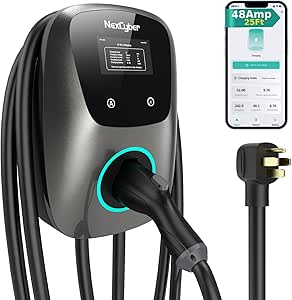
The NexCyber stands out for drivers who want charging controls and energy tracking alongside a higher-power setup. Its app offers scheduling, cost tracking, and charging history, while the touch screen provides controls at the unit. It can deliver up to 48A when hardwired, but the supplied NEMA 14-50 plug configuration is specified for 40A; that distinction matters when comparing it with the hardwired 48A charger in this roundup. Compared with the plug-in EVIQO 40A, NexCyber offers more app detail and a higher hardwired ceiling, at the cost of a more involved installation for full output. Its 25-foot cable is rated for over 10,000 charges, though the unit is not recommended for direct sun or heavy rain. Tesla drivers need a separate adapter.
Pros:- App includes scheduling, cost tracking, and charging history
- Adjustable amperage from 16A to 48A supports different setups
- 25-foot cable is rated for over 10,000 charges
- ETL, FCC, and Energy Star certifications with a 3-year warranty
Cons:- The NEMA 14-50 configuration is specified for 40A; 48A requires hardwiring
- Full-output installation requires professional work and suitable wiring
- Not recommended for direct sunlight or heavy rain exposure
Best for: EV owners who want app-based charging cost records and may later hardwire a higher-output charger
Not ideal for: Renters or buyers seeking a simple plug-in installation at full 48A output, or those with an exposed charging location
- Maximum current:48A hardwired; 40A with NEMA 14-50 plug
- Voltage:240 V
- Amperage range:16A–48A adjustable
- Connector:J1772
- Plug:NEMA 14-50P
- Cable length:25 ft
- Certifications:ETL, FCC, Energy Star
- Warranty:3 years
Our verdict“Pick the NexCyber if charging records and flexible app controls matter enough to justify careful installation planning.”
EVIQO Level 2 EV Charger, 40A J1772, NEMA 14-50
For drivers who already have the right outlet and want more output than a 32A portable charger, the EVIQO offers a clear step up without requiring hardwiring. It delivers up to 40A from a dedicated 50A circuit and includes app controls for scheduling and energy tracking. Compared with the AIMILER, it raises the current ceiling and has stated IP66/NEMA 4 weather protection, making it a stronger fit for a suitable outdoor location. The tradeoff is that the outlet and circuit requirements are specific, and the Wi-Fi features need a 2.4 GHz network. Its 25-foot cable and glow-in-the-dark holster help with everyday parking and cable storage. Tesla compatibility relies on the vehicle’s J1772 adapter, so buyers should confirm they have one.
Pros:- 40A output provides a higher ceiling than the 32A AIMILER
- 25-foot cable and IP66/NEMA 4 protection suit flexible placement
- App supports charging control, scheduling, and energy tracking
- Glow-in-the-dark holster is easier to locate in a dark garage
Cons:- Requires a NEMA 14-50 outlet on a dedicated 50A circuit
- Wi-Fi functions require a 2.4 GHz network
- Tesla use depends on having the vehicle’s J1772 adapter
Best for: J1772 EV and plug-in hybrid owners with a dedicated NEMA 14-50 outlet on a 50A circuit who want 40A charging
Not ideal for: Drivers without the required outlet and circuit, or households whose Wi-Fi network only supports 5 GHz
- Maximum current:40 A
- Voltage:240 V
- Circuit requirement:Dedicated 50 A circuit
- Outlet:NEMA 14-50
- Connector:J1772
- Cable length:25 ft
- Weather protection:IP66 / NEMA 4
- Warranty:3 years
Our verdict“Choose the EVIQO if you have the specified 50A outlet circuit and want a weather-protected 40A plug-in charger.”
48A Level 2 Hardwired J1772 EV Charger, 11.5 kW
This 48A charger is aimed at homeowners ready to install a dedicated charging station, with up to 11.5 kW output and current adjustment in 1A steps. The IP65 enclosure supports indoor or outdoor placement, and the 25-foot cable helps reach a parked car without moving the unit. Compared with the NexCyber, it has a more clearly specified hardwired setup: a dedicated 240V/60A circuit and licensed electrician are required. That makes it a better match for a planned permanent installation than for someone seeking a plug-in unit. App scheduling, monitoring, and remote start or stop add control, while the 3-year warranty provides a defined coverage period. J1772 keeps it suited to many North American EVs, but Tesla owners need a separate J1772-to-NACS adapter.
Pros:- Up to 48A and 11.5 kW output with 1A current adjustments
- IP65 enclosure is rated for indoor and outdoor use
- App offers scheduling, monitoring, and remote start or stop
- Includes a 25-foot cable and 3-year warranty
Cons:- Hardwiring requires a dedicated 240V/60A circuit and licensed electrician
- Tesla vehicles require a separate J1772-to-NACS adapter
Best for: Homeowners planning a permanent 48A installation who need a 25-foot cable and an enclosure rated for outdoor use
Not ideal for: Renters, frequent movers, or buyers without access to a dedicated 60A circuit and licensed electrician
- Maximum current:48 A
- Power:11.5 kW
- Voltage:240 V
- Installation:Hardwired; dedicated 240V/60A circuit and licensed electrician required
- Current adjustment:10A–48A in 1A increments
- Connector:SAE J1772
- Cable length:25 ft
- Weather resistance:IP65
- Warranty:3 years
Our verdict“Choose this charger for a permanent 48A installation when outdoor-rated protection and fine current adjustment matter.”
ELEGRP 48A Level 2 J1772 EV Charger, 11 kW, Hardwired, 25 ft Cable
The ELEGRP is the lineup’s most tailored option for a shared home charging spot: its RFID access control can help limit who starts a session, while the app handles scheduling and energy tracking. Its 48A, 11 kW output puts it in the same high-power hardwired class as the 48A charger above, but the IP66/NEMA Type 4 rating and stated operating temperature range make its outdoor-use case more explicit. Buyers give up some warranty coverage, with a 2-year replacement warranty compared with the other hardwired pick’s 3 years. Installation still calls for a dedicated 60A circuit and a professional electrician. Its 2.4 GHz Wi-Fi requirement and J1772 connector also narrow the fit for homes with incompatible networks or vehicles without an adapter.
Pros:- RFID access control helps manage use of a shared charger
- 48A output and 11 kW power suit a high-capacity hardwired setup
- IP66/NEMA Type 4 rating supports outdoor installation
- App includes scheduling and real-time energy tracking
Cons:- Requires hardwiring to a dedicated 60A circuit by a professional electrician
- 2-year replacement warranty is shorter than the other hardwired 48A option’s 3 years
- 2.4 GHz Wi-Fi and J1772 connector may require network or vehicle-port adapters
Best for: Households sharing one charging station that want RFID access control, app tracking, and a hardwired 48A setup
Not ideal for: Buyers seeking plug-in portability, a longer warranty, or native compatibility with a non-J1772 vehicle port
- Maximum current:48 A
- Power:11 kW
- Installation:Hardwired; dedicated 60 A circuit; professional electrician required
- Current adjustment:8A–48A
- Connector:SAE J1772
- Cable length:25 ft
- Connectivity:2.4 GHz Wi-Fi
- Access control:RFID card
- Warranty:2-year replacement warranty
Our verdict“Pick the ELEGRP for a shared hardwired charging space where RFID access matters more than a longer warranty.”
EVWallbox Level 2 EV Charger with J1772 Connector and 25-Foot Cable
The EVWallbox suits drivers who want to schedule and monitor home charging from an app without stepping up to a charger whose listed output is 48 amps. Its adjustable current gives owners some control over charging, while the display and included RFID card add access and session information at the unit. Compared with the ApexCharger MACH 1, EVWallbox has a larger 4.3-inch display and a 25-foot cable; ApexCharger offers a 30-foot cable, a stated 48-amp maximum and a Tesla NACS adapter. EVWallbox’s weather-resistant, IP65-rated enclosure supports indoor or outdoor placement. The key limitation is that the product details give no maximum amperage or charging power, so buyers cannot readily compare its charging capacity with specified 32A, 40A or 48A options. Its J1772 plug may also call for an adapter on some vehicles.
Pros:- App supports scheduling, current adjustment and session monitoring
- 25-foot cable offers flexible reach from the outlet or installation point
- IP65-rated enclosure is suited to indoor and outdoor placement
- 4.3-inch display and included RFID card add at-unit information and access control
Cons:- Maximum amperage and charging power are not specified in the product details
- J1772 connector may require an adapter for vehicles with a different inlet
Best for: EV owners who want app scheduling, current adjustment and a clear on-unit display for a J1772 home charging setup
Not ideal for: Drivers who need a confirmed charging rate or built-in Tesla NACS compatibility, since the listed details do not specify maximum amperage and the connector is J1772
- Voltage:240V
- Connector:SAE J1772
- Cable length:25 ft
- Plug:NEMA 14-50
- Display:4.3-inch
- Controls:Smartphone app, adjustable current and charging schedules
- Included access:RFID card
- Certifications:ETL, FCC and CE
Our verdict“Choose EVWallbox if app scheduling and its large display matter more to you than a clearly specified maximum charging rate.”
ApexCharger MACH 1 48 Amp Level 2 EV Charging Station with J1772 Connector and Tesla NACS Adapter, 200-240V, 30ft Cable
The ApexCharger MACH 1 is the more adaptable pick for buyers choosing between a plug-in setup and a higher-output hardwired installation. With a NEMA 14-50 connection, it supports 40A or 50A breakers; hardwiring with a 60A breaker enables its full 48A output. That makes it more clearly specified than the EVWallbox, whose maximum current is not listed, though EVWallbox has the larger display. ApexCharger also includes a PRO 1 NACS adapter for Tesla vehicles and a 30-foot cable, giving it broader out-of-box reach than the J1772-only options. Wi-Fi, Bluetooth, app controls and RFID cards add ways to manage access and sessions. The tradeoff is practical: getting full output requires hardwiring and electrical work, while the smaller 2.4-inch panel offers less screen space than EVWallbox’s 4.3-inch display.
Pros:- Included NACS adapter supports Tesla charging alongside its J1772 connector
- 30-foot cable provides more reach than the 25-foot EVWallbox cable
- Can be plugged in or hardwired for up to 48A output
- Wi-Fi, Bluetooth, app controls and two RFID cards support connected charging and access management
Cons:- Full 48A output requires hardwiring and a 60A breaker
- App features may require setup and an account
- 2.4-inch display is smaller than EVWallbox’s 4.3-inch screen
Best for: Households with different EV makes that want a 30-foot cable and the choice of plug-in installation or 48A hardwiring
Not ideal for: Drivers who need full 48A output without hardwiring, or who prefer a simpler charger without app setup
- Maximum current:48A
- Voltage:200–240V
- Connector:J1772
- Tesla compatibility:PRO 1 NACS adapter included
- Cable length:30 ft
- Installation:NEMA 14-50 plug (40A or 50A breaker) or hardwired (48A output with 60A breaker)
- Connectivity:Bluetooth and Wi-Fi
- Display:2.4-inch LED panel
- Included accessories:Two RFID cards, cable holder, anti-theft bolt and fittings, hardwiring kit
Our verdict“Pick the MACH 1 if you want Tesla adapter compatibility and installation flexibility, and can arrange hardwiring for its full output.”
How We Picked
I ranked these chargers by the decisions that affect everyday home charging: usable amperage, installation requirements, cable reach, controls, and connector fit. A higher stated output only helps when the vehicle can accept it and the home circuit is sized for it. I gave plug-in options credit for easier removal or relocation, and hardwired units credit for fitting a dedicated installation where a plug is not desired. Smart features count when they add practical scheduling or monitoring, but they do not outweigh electrical compatibility or a clear installation fit.
The order favors the Emporia as the strongest all-around blend of output, smart controls, and plug-in flexibility. The hardwired 48A chargers follow for buyers prioritizing a fixed high-output setup, while 32A and 40A plug-in models rank well for drivers balancing capability with a 14-50 outlet. Lower-power, minimally specified, and connector-specific options fit narrower needs, so they rank lower as general recommendations. Product details in the supplied names are limited for some models; where they do not establish features such as app support or certification, I do not assume them.
| electric car charger | Connector |
|---|---|
| 16A Adjustable Level 1 and Lev | SAE J1772 |
| EVIQO Level 2 J1772 48A Hardwi | J1772 |
| EVDANCE Level 2 EV Charger | SAE J1772 |
| Emporia Level 2 EV Charger | SAE J1772 |
| EVDANCE Level 2 EV Charger 40A | J1772 |
| AIMILER Level 2 EV Charger | J1772 |
| Level 2 EV Charger | J1772 |
| EVIQO Level 2 EV Charger | J1772 |
| 48A Level 2 Hardwired J1772 EV | SAE J1772 |
| ELEGRP 48A Level 2 J1772 EV Ch | SAE J1772 |
| EVWallbox Level 2 EV Charger w | SAE J1772 |
| ApexCharger MACH 1 48 Amp Leve | J1772 |
Factors to Consider When Choosing Best Electric Car Chargers
Before choosing a charger, I would start with the electrical setup and the car rather than the charger’s headline amperage. Those two constraints determine what the unit can deliver, how it must be installed, and whether a plug-in model is suitable.
Match charger output to the car and circuit
A charger’s listed amperage is its maximum capability, not a promise that every car or home can use it. Check the vehicle’s onboard AC charging limit and the breaker and wiring capacity before comparing 32A, 40A, and 48A models. Continuous charging loads require circuit sizing that follows local electrical rules, so a standard outlet or existing breaker may not support the unit you want. Paying for more output can make sense if your car can accept it and the circuit is designed for it. If either limit is lower, a higher-rated charger may offer little daily benefit. Have a qualified electrician verify the installation plan when the circuit details are uncertain.
Choose plug-in or hardwired based on the installation
A NEMA 14-50 charger can be unplugged for replacement or relocation, but that convenience depends on having a properly installed receptacle and a circuit rated for the charging load. Do not assume an existing 14-50 outlet is suitable just because its shape matches the plug. Hardwired units avoid a receptacle connection and can be a tidy fit for a permanent charging spot, though they call for a fixed installation. Compare total installation scope, including the route from the electrical panel, not just the charger. Renters or people who expect to move may favor a plug-in setup if the property already supports it. Homeowners planning a long-term parking location may prefer hardwiring after checking local requirements.
Measure the route from the charger to the charge port
Cable length is measured from the charger, but the useful reach depends on where the unit sits and where your car’s charge port is located. Measure the real path around the vehicle, allowing enough slack to connect without stretching the cable across a walkway or driveway. The 25-foot cables common among these picks suit many garages, while ApexCharger’s 30-foot cable may help with a farther parking position. A longer cable can add weight and require more storage space, so extra length is not always an advantage. Plan for both current and likely future vehicles if you may change cars. Keep the cable route clear of doors, tires, and spots where it could be damaged.
Decide whether app controls solve a real problem
Wi-Fi and app controls can help you schedule charging, check activity, or manage energy use, but their usefulness depends on reliable network coverage where the charger will be installed. Ask whether your vehicle already provides the scheduling or charging information you need; overlapping apps can add friction. A charger with fewer controls may be easier to operate for households that simply plug in overnight. Consider how charging schedules interact with utility plans and household routines before paying for connected features. If the garage has weak Wi-Fi, confirm what functions remain available offline. Keep access to basic charging controls in mind for other household drivers.
Check connector fit and adapter plans
J1772 is the connector listed for most chargers in this roundup, while ApexCharger MACH 1 includes a Tesla NACS adapter. Verify the connector your car accepts and whether an adapter is approved for that vehicle and charging setup. An included adapter can simplify compatibility for a particular car, but it does not make every charger universal. Consider future vehicles in the household before choosing a connector-specific arrangement. Also check whether an adapter adds handling steps or needs separate storage. The best choice is the one that works reliably with the cars you actually expect to charge.
Look beyond the hardware for installation and support details
A charger purchase includes more than the box: installation labor, electrical upgrades, cable management, and any needed permits can shape the real project. Check the manufacturer’s installation instructions, warranty terms, and support channels before committing, especially for a hardwired unit. Confirm any certification claims on the product listing or documentation rather than inferring them from a model name. A feature-rich charger is less useful if replacement parts or support are difficult to obtain. For outdoor mounting, verify weather suitability and the installation conditions specified by the manufacturer. These checks can prevent a technically compatible charger from becoming a poor fit for the property.
Frequently Asked Questions
Should I choose a 32A, 40A, or 48A home charger?
Choose based on the lowest practical limit among your car, circuit, and charging routine. A 48A unit can shorten charging time only if the vehicle accepts that level of AC power and the home installation supports the load. A 32A or 40A model may already replenish the battery overnight for many drivers, while easing the need for a higher-capacity circuit. Compare how much energy you typically need between driving days instead of choosing by the largest number alone. If you plan to change vehicles, factor in likely future charging capability too.
Is a 14-50 plug-in charger safe to use with an existing outlet?
The plug fitting the outlet does not confirm that the outlet, wiring, and breaker are suitable for continuous EV charging. Have the circuit checked for its rating, condition, and installation quality before using a high-current charger. Some homes may need a dedicated circuit or electrical work even when a 14-50 receptacle is already present. The charger’s current setting must also stay within the circuit’s permitted capacity. Follow the charger instructions and local electrical requirements, and get an electrician’s assessment if the setup is unclear.
When is hardwiring a better choice than a plug-in charger?
Hardwiring can suit a permanent charging location when you want a fixed installation and do not need to unplug the unit. It can also avoid relying on a receptacle connection, though the electrical work still needs to match the charger and local code. A plug-in charger offers easier removal or replacement, provided the outlet is correctly installed for the load. Compare the installation quote and the practical value of being able to move the charger. If you expect to relocate or may charge at another property, plug-in flexibility can be useful.
Do I need a Wi-Fi charger if my car already has a charging app?
Not necessarily. Your car’s app may already handle scheduling and charging status, making a charger app redundant for everyday use. Charger-side controls can still help if you want to manage charging independently of the vehicle or coordinate energy use at home. Check which functions work without an internet connection and whether the charger’s app supports your phone and network. If you rarely adjust charging times, a simpler model may be easier for everyone in the household.
Will a J1772 charger work with a Tesla or a future NACS vehicle?
Compatibility depends on the vehicle, its charging port, and the approved adapter arrangement for AC charging. This roundup lists mostly J1772 chargers, while ApexCharger MACH 1 includes a Tesla NACS adapter; verify the exact vehicle guidance before purchase. Do not assume an adapter works across every model or charging scenario. If you expect to own different connector types, compare the cost and convenience of approved adapters with choosing a charger that includes one. Confirm that the charger’s cable and adapter arrangement is practical for your parking position.
Conclusion
I would choose the Emporia Level 2 as the best overall pick for drivers who want 48A capability, Wi-Fi controls, and a plug-in format. For a value-focused setup, the EVDANCE 32A is the more restrained plug-in choice when its output fits the car and circuit. Beginners who want a lower-power, adjustable approach can start with the 16A Level 1/Level 2 model, after checking its connection and installation requirements. For a premium fixed installation, compare the EVIQO 48A hardwired and ELEGRP 48A hardwired options against electrician advice and your vehicle’s charging limit. If cable reach or connector flexibility drives the decision, consider ApexCharger MACH 1 with its 30-foot cable and included NACS adapter; confirm compatibility before buying.
Fall Picks
fall essentials
As an affiliate, we earn on qualifying purchases.