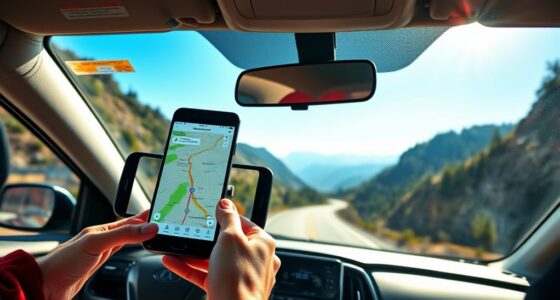
Relying heavily on GPS can weaken your brain’s natural navigation skills by reducing its engagement with landmarks, routes, and spatial reasoning. Over time, this dependence can diminish your hippocampus’s ability to form and recall mental maps, making you more reliant on external directions. If you keep using GPS constantly, your ability to navigate without it might decline further. To understand how to keep your brain sharp, see what strategies can help preserve your navigation skills.
Key Takeaways
- Overusing GPS reduces active engagement of the hippocampus, weakening spatial memory and mental map formation.
- Relying solely on digital directions diminishes the brain’s natural navigation skills over time.
- Navigating without GPS helps reinforce neural pathways involved in landmark recognition and spatial reasoning.
- Excess dependence on GPS can impair the brain’s ability to adapt to unfamiliar environments.
- Practicing occasional non-GPS navigation maintains neural resilience and supports long-term spatial memory.

Have you ever relied on GPS to find your way and wondered how it affects your brain? When you trust your device to guide you through unfamiliar streets or even familiar routes, you’re engaging in a form of neural navigation—your brain’s way of creating and updating a mental map of your environment. This process involves spatial memory, which allows you to remember the layout of places, recognize landmarks, and navigate without constant assistance. But with GPS doing much of the work, your brain’s role in navigation diminishes, potentially impacting your spatial memory over time.
When you depend heavily on GPS, your brain doesn’t get the chance to exercise its navigation skills. Instead of actively engaging in route planning, landmark recognition, and spatial reasoning, you follow directions passively. This reduced engagement can lead to a decline in neural navigation capabilities. Your hippocampus, a key brain region involved in spatial memory and navigation, might become less stimulated. Over time, this could weaken your ability to form new mental maps or recall familiar routes, making you more reliant on external cues rather than your internal navigation system.
The relationship between GPS use and spatial memory isn’t just about convenience; it’s about how your brain adapts to technology. When you navigate without GPS, your hippocampus actively works to create a detailed, internal representation of your surroundings. You remember landmarks, street layouts, and directional cues, reinforcing your neural pathways associated with spatial awareness. Conversely, with GPS guiding you turn-by-turn, your brain fundamentally hands over the task, leading to less practice in spatial reasoning and less robust neural navigation.
This doesn’t mean you should abandon GPS entirely, but it’s worth considering how you use it. Over-reliance can make your spatial memory weaker, which might be problematic if you find yourself in a situation without digital assistance. To keep your brain sharp, try to occasionally navigate without GPS, especially in familiar areas. Pay attention to landmarks, street signs, and your surroundings. Engage your hippocampus by mentally mapping your route or recalling previous journeys. This active involvement helps preserve your neural navigation skills and keeps your spatial memory strong.
In the end, technology should complement your natural abilities, not replace them. Using GPS sparingly and intentionally can help you maintain the neural navigation skills that keep your brain flexible and sharp. Remember, the more you challenge your spatial memory, the better your brain adapts and thrives—even in a digital world. Incorporating mental mapping exercises into your routine can further enhance your neural resilience and spatial awareness.

Garmin 010-02256-00 eTrex 22x, Rugged Handheld GPS Navigator, Black/Navy
- Reliable Handheld GPS: Explore confidently with this device
- Sunlight-Readable Display: 2.2-inch color screen with high visibility
- Preloaded Topo Maps: Includes routable roads and trails for outdoor activities
As an affiliate, we earn on qualifying purchases.
As an affiliate, we earn on qualifying purchases.
Frequently Asked Questions
Can Relying on GPS Improve or Impair Spatial Memory Skills?
Relying on GPS can impair your spatial memory skills by increasing cognitive reliance on technology instead of your natural navigation abilities. Over time, this memory decline occurs because your brain isn’t challenged to create mental maps or remember routes. While GPS offers convenience, excessive dependence might weaken your ability to navigate independently, so it’s best to occasionally rely on traditional methods to keep your spatial skills sharp.
How Does GPS Usage Affect Long-Term Navigation Abilities?
Using GPS regularly can weaken your long-term navigation abilities by reducing your reliance on cognitive mapping and mental rotation skills. As you depend on technology, your brain may stop actively engaging in spatial reasoning, leading to less developed internal maps. Over time, this diminished mental effort makes it harder to navigate independently, decreasing your ability to visualize routes and adapt to new environments without GPS assistance.
Are There Age Groups More Vulnerable to GPS Dependence?
You might think tech-savvy teens are immune, but surprisingly, they’re more vulnerable to GPS dependence because of age-related decline in natural navigation skills. Ironically, their comfort with technology can cause them to rely excessively on GPS, weakening their spatial awareness over time. Older adults, despite less familiarity with gadgets, often retain better internal navigation skills, making them less dependent. So, your age truly influences how GPS impacts your brain’s navigation abilities.
What Are Alternative Ways to Develop Natural Navigation Skills?
To develop your natural navigation skills, focus on building mental mapping by paying attention to landmarks and remembering routes. Enhance your sensory awareness by observing sounds, smells, and sights around you as you navigate. Practice without GPS regularly, sketching maps or recalling routes mentally. These strategies strengthen your brain’s ability to create internal maps, making you less dependent on technology and more confident in exploring unfamiliar places.
Does GPS Use Influence the Brain’s Structure Over Time?
GPS use can influence your brain’s structure over time by affecting cognitive adaptation and neural plasticity. When you rely heavily on GPS, your brain may weaken its natural navigation skills, reducing activity in areas responsible for spatial awareness. This dependence can lead to decreased neural plasticity in those regions, making it harder to develop or regain natural navigation abilities if you stop using GPS frequently.

iONCT AI Smart Glasses with Camera, 8MP HD Bluetooth Camera Glasses,1080P Video Recording,Real Time Translation Sunglasses,AI Assistant,Object Recognition,Open-Ear Music for Travel, Meetings Vlog
- 4K Video and 32MP Photos: Ultra-HD videos with EIS stabilization
- Hands-Free Voice Control: Capture photos and videos via voice commands
- Bluetooth Calling with Noise Cancellation: High-quality stereo sound and clear calls
As an affiliate, we earn on qualifying purchases.
As an affiliate, we earn on qualifying purchases.
Conclusion
So, next time you rely on GPS, remember Icarus’s caution—flying too close to technology might make you lose your way. Your brain’s natural navigation skills are like a trusty compass, but constant guidance can dull that sense. Embrace your internal map once in a while; it’s the secret to truly knowing your path. After all, even Da Vinci’s genius thrived through curiosity and exploration, not just directions. Trust yourself, and find your way.

SILAIDESI Dementia Prevention Puzzle Cube for Seniors – Brain Boosting Memory Game, Anti-Slip Large Blocks with Easy-Rotate Design for Alzheimer's Care (Space Pattern)
- Brain Health Support: Stimulates memory and reasoning
- Progressive Challenges: Simple and advanced puzzle modes
- Senior-Friendly Design: Large, easy-to-hold blocks
As an affiliate, we earn on qualifying purchases.
As an affiliate, we earn on qualifying purchases.
GPS Master- Navigation Free
- Offline GPS Navigation: Navigation without internet connection
- User-Friendly Interface: Easy to use and navigate
- Accident Alert Notifications: Alerts for potential accidents
As an affiliate, we earn on qualifying purchases.
As an affiliate, we earn on qualifying purchases.