If your older car uses OBD-I, diagnosing problems involves specific, brand-dependent tools and connectors, making troubleshooting more complex. OBD-I systems don’t have a standardized diagnostic port or communication method, so you often need manufacturer-specific equipment. In contrast, OBD-II offers a universal 16-pin connector and digital protocols, making diagnostics quicker and more straightforward. To understand how these differences affect vehicle diagnostics and repair, keep exploring the details behind each system.
Key Takeaways
- OBD-I uses manufacturer-specific connectors and codes, making diagnostics more complex and less standardized.
- OBD-II features a universal 16-pin connector, allowing use of common scan tools across different vehicle makes.
- OBD-I offers limited data and primarily monitors emissions, while OBD-II provides real-time sensor data and detailed trouble codes.
- OBD-II employs digital communication protocols, enabling faster and more accurate problem diagnosis than the analog signals of OBD-I.
- OBD-II improves diagnostic efficiency, reduces repair time, and ensures compliance with strict emission regulations, unlike the more basic OBD-I system.

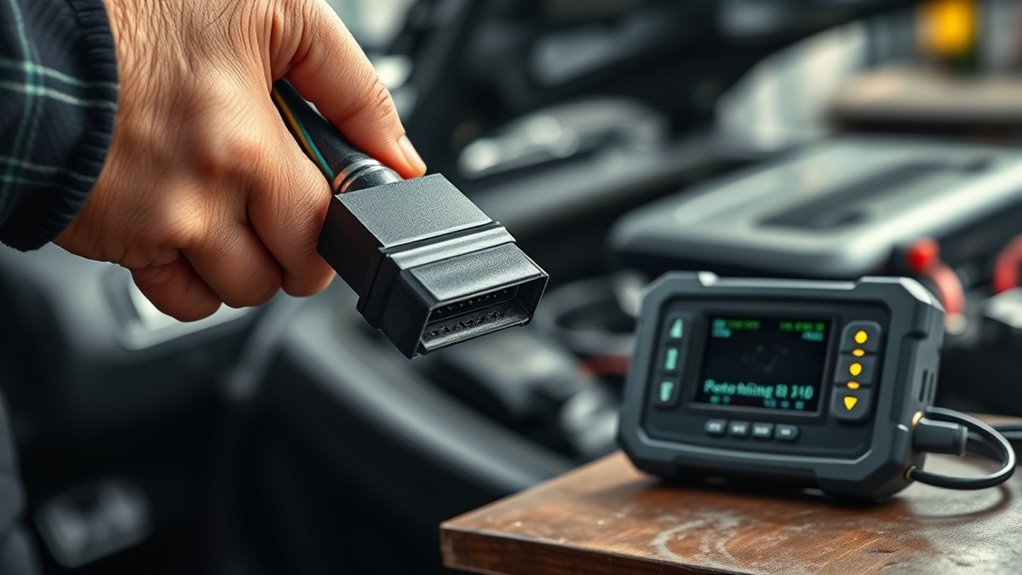
If you’re comparing vehicle diagnostics systems, understanding the differences between OBD-I and OBD-II is essential. OBD-I was the first generation of onboard diagnostics systems introduced in the 1980s, primarily designed to monitor emissions and engine performance. It used a variety of diagnostic connectors, which varied by manufacturer and vehicle model, making it difficult to standardize repairs or diagnostics across different vehicles. These connectors were often proprietary, so mechanics needed specific tools for each brand, limiting the system’s versatility. In contrast, OBD-II, introduced in the mid-1990s, brought a standardized diagnostic connector—usually a 16-pin connector—that made it easier to connect scan tools and retrieve data. This uniformity considerably improved diagnostics, allowing mechanics and vehicle owners to use the same tools across different makes and models.
Another key difference lies in emission standards. OBD-I systems were primarily focused on emission controls, but they didn’t have strict requirements for monitoring or reporting emissions. The emission standards varied by manufacturer and region, leading to inconsistent diagnostics. OBD-II, however, was mandated by the government to meet strict emission standards, making its diagnostic capabilities more extensive. It constantly monitors the performance of various emission-related components and systems, and it can store trouble codes when emissions aren’t within acceptable limits. This means with OBD-II, you can quickly identify issues that might cause your vehicle to fail emissions testing, ensuring compliance with regulatory standards.
Furthermore, the way these systems communicate differs. OBD-I systems used analog signals and manufacturer-specific codes, which limited the amount of information available to technicians. They often required special equipment to interpret these signals, and troubleshooting could be more time-consuming. On the other hand, OBD-II uses a digital communication protocol, standardized across all vehicles using the system. It provides a wealth of data—like real-time sensor readings and precise trouble codes—that helps you pinpoint the exact problem efficiently. This level of detail enables quicker repairs and better vehicle maintenance, ultimately saving you time and money.
Additionally, the compatibility of OBD-II with modern diagnostic tools makes it an invaluable diagnostic standard for contemporary vehicle maintenance.
Frequently Asked Questions
Can I Upgrade My Older Car to OBD-II Standards?
You can upgrade your older car to OBD-II standards, but retrofit compatibility varies. You’ll face some upgrade challenges, like installing a new diagnostic port and connecting the appropriate sensors. It’s not always straightforward, so you might need professional help or specialized kits. Keep in mind that the process can be costly and complex, but if done correctly, it allows your vehicle to communicate with modern diagnostic tools effectively.
How Accurate Are OBD-I Diagnostics Compared to OBD-II?
Your OBD-I system’s diagnostic accuracy is like trying to hit a tiny bullseye with a blindfold, making it less reliable than OBD-II. While OBD-I can identify some issues, its system reliability and data precision are limited. OBD-II offers much more detailed, consistent, and extensive diagnostics, making it considerably more accurate for pinpointing problems. So, if you want reliable diagnostics, upgrading to OBD-II is the smarter choice.
Are There Specific Tools Needed for OBD-I Diagnostics?
Yes, you need specific diagnostic tools for OBD-I diagnostics. These tools are designed to connect to the older diagnostic ports and are often model-specific, so make certain they’re compatible with your vehicle’s sensors. Unlike OBD-II, which uses a standardized connector, OBD-I tools vary, and sensor compatibility is vital for accurate readings. Make sure to select the right scanner to effectively diagnose issues in your older car.
How Long Do OBD-I and OBD-II Systems Typically Last?
You can generally expect OBD-I systems to last around 10-15 years, while OBD-II systems tend to be more durable, often lasting 15-20 years or more. The diagnostic lifespan depends on system durability and how well you maintain your vehicle. Regular upkeep, avoiding harsh conditions, and timely repairs help extend the lifespan of these diagnostic systems, ensuring they continue to accurately monitor and diagnose your vehicle’s health over time.
Do All Vehicles Eventually Transition From OBD-I to OBD-II?
Not all vehicles eventually shift from OBD-I to OBD-II. Vehicle compatibility plays a key role, as manufacturers adopted the diagnostic evolution at different times. Some older cars may never upgrade because they use different systems or lack the necessary connectors. As technology advances, newer vehicles typically adopt OBD-II, but many older models remain with OBD-I, highlighting the gradual and uneven nature of diagnostic evolution across vehicle generations.
Conclusion
So, after all this, it’s ironic how older cars with OBD-I seem almost nostalgic, yet struggle to tell you what’s wrong. You’d think simpler diagnostics would be easier, but they hide their secrets better than the more advanced OBD-II systems. In the end, your vintage ride’s charm might come with a little frustration, reminding you that sometimes technology’s progress makes fixing problems a little less mysterious—though not always easier.