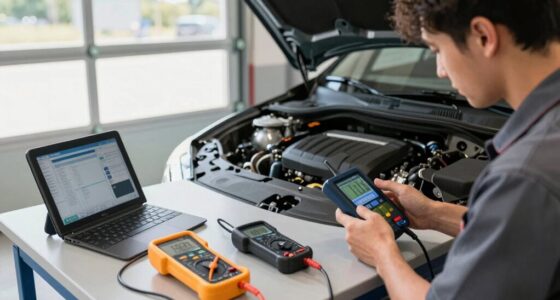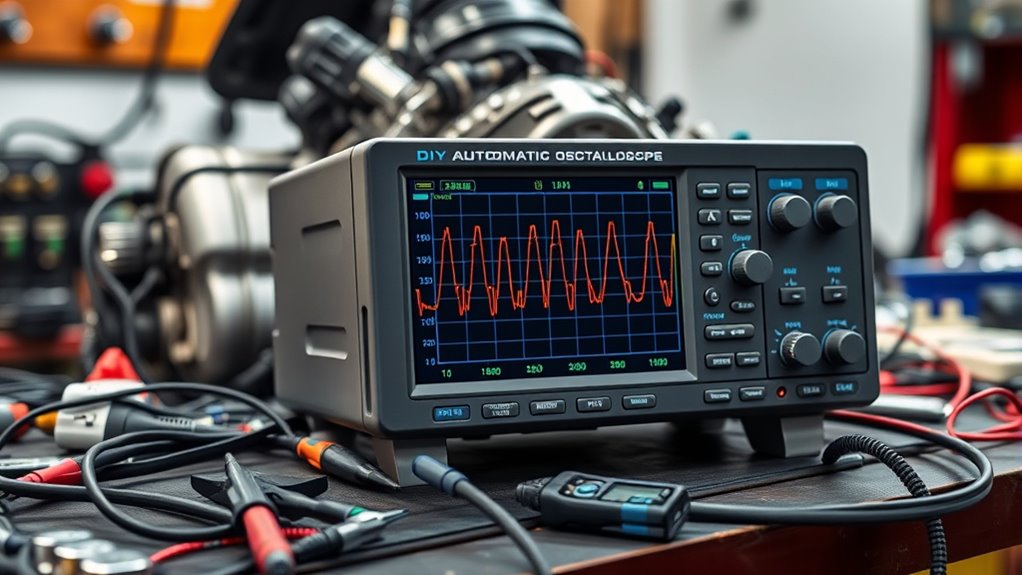

If you’re serious about DIY vehicle repairs, an automotive oscilloscope can be a game-changer. It helps you see real-time electrical signals, making diagnostics more precise than just using a multimeter. While it might seem intimidating at first, it can uncover hidden faults and faulty sensors that are hard to detect otherwise. Keep exploring, and you’ll discover how this powerful tool can elevate your troubleshooting skills and confidence in vehicle repairs.
Key Takeaways
- Automotive oscilloscopes provide real-time visualization of electrical signals, enabling more accurate diagnostics than multimeters.
- They help identify complex issues like signal noise, distortions, and intermittent faults often missed otherwise.
- Using an oscilloscope improves sensor testing and troubleshooting of modern vehicle electronics and control modules.
- While initially intimidating, learning to use an oscilloscope greatly enhances DIY diagnostic capabilities and problem-solving skills.
- Investing in this professional tool can save time, reduce guesswork, and increase confidence in vehicle repairs.

Automotive oscilloscopes are essential tools for diagnosing and troubleshooting modern vehicle electrical systems. These devices allow you to visualize electrical signals in real-time, making it easier to identify issues that might be hidden behind complex wiring or subtle sensor anomalies. If you’re serious about DIY diagnostics, understanding how an oscilloscope can improve your troubleshooting process can be a game-changer. One key application is circuit analysis, where you need to examine how electrical signals behave across various components. Instead of relying solely on multimeters, which give you static voltage readings, an oscilloscope provides a dynamic view, showing you waveforms that reveal distortions, noise, or irregularities. By analyzing these waveforms, you can pinpoint faults like short circuits, open circuits, or faulty connections with greater accuracy. This detailed insight saves you time and reduces guesswork, especially when dealing with complex wiring harnesses or digital signals. Additionally, mastering how to interpret these signals enhances your overall understanding of vehicle electronics and can help prevent future issues.
Sensor testing is another vital area where an automotive oscilloscope proves invaluable. Modern vehicles depend heavily on sensors—such as oxygen sensors, throttle position sensors, and crankshaft position sensors—to relay critical data to the engine control unit (ECU). When a sensor malfunctions, it often produces signals that deviate from normal patterns. With an oscilloscope, you can directly observe these signals and verify whether they fall within expected ranges. For instance, if you’re troubleshooting a hesitation or poor fuel economy, checking the sensor outputs with an oscilloscope can confirm if the sensor is sending accurate data or if it’s faulty. This real-time visualization helps you determine whether the problem lies in the sensor itself or elsewhere in the system. Furthermore, sensor testing with an oscilloscope enables you to catch intermittent issues that a multimeter might miss, such as fluctuating signals or noise interference.
Using an automotive oscilloscope may seem intimidating at first, but once you understand its capabilities, you’ll find it becomes an indispensable part of your diagnostic toolkit. It empowers you to perform detailed circuit analysis, uncover hidden faults, and verify sensor performance with confidence. Whether you’re working on engine management systems, ignition circuits, or emissions control, this pro-level tool offers insights beyond basic voltage measurements. Investing in an oscilloscope means you’re equipped to tackle complex electrical problems head-on, gaining a clearer picture of what’s happening under the hood. In the long run, it can save you time, money, and frustration by enabling precise diagnostics rather than relying on guesswork or trial-and-error methods. If you’re committed to DIY vehicle repair or even professional diagnostics, an automotive oscilloscope is a smart addition that elevates your ability to troubleshoot effectively. Developing fundamental knowledge of how electrical signals behave in automotive systems can significantly improve your diagnostic accuracy and confidence.

Hantek 1008C PC USB 8CH Automotive Diagnostic Digital Oscilloscope/DAQ/Programmable Generator
- 8-Channel Automotive Oscilloscope: Supports vehicle testing and diagnostics
- Over 80 Diagnostic Functions: Includes ignition, sensor, bus, starter, and charging tests
- Video Help Function: Provides online diagnostic video tutorials
As an affiliate, we earn on qualifying purchases.
As an affiliate, we earn on qualifying purchases.
Frequently Asked Questions
Can Automotive Oscilloscopes Diagnose Hybrid Vehicle Systems Effectively?
Yes, you can use automotive oscilloscopes for hybrid diagnostics and high voltage testing effectively. They allow you to visualize complex electrical signals, identify faults, and guarantee safe handling of high-voltage components. With the right skills, a scope helps you troubleshoot hybrid systems accurately, making it a valuable tool for DIYers who want professional-grade diagnostics. Just remember to follow safety protocols during high voltage testing to prevent accidents.
What Is the Typical Lifespan of an Automotive Oscilloscope?
An automotive oscilloscope typically lasts around 5 to 10 years, depending on how well you maintain it. Regular oscilloscope maintenance and proper calibration procedures help extend its lifespan. You should periodically check for software updates, keep the device clean, and calibrate it according to the manufacturer’s instructions. Proper care guarantees accurate readings and prolongs your oscilloscope’s usability, making it a reliable tool for your DIY diagnostics over time.
Are There Budget-Friendly Oscilloscopes Suitable for Beginners?
Think of finding a budget-friendly oscilloscope as discovering a reliable map in a vast forest. You can definitely find beginner models that are affordable and easy to use, making them perfect for DIY diagnostics. These budget options offer essential features without the high cost, helping you learn and grow your skills. Whether you’re just starting or working on simple repairs, these beginner models serve as a solid foundation for your automotive troubleshooting journey.
How Portable Are Automotive Oscilloscopes for Field Repairs?
Automotive oscilloscopes are quite portable, thanks to their lightweight, compact design. Many models feature battery operation, so you can perform field repairs without needing a power outlet. This portable design makes it easy to carry the scope to different locations, whether you’re working in a driveway or at a repair site. With battery-powered options, you gain the flexibility to diagnose issues efficiently, even in remote or hard-to-reach areas.
Do Oscilloscopes Require Special Training to Operate Properly?
Like a knight needing to learn swordsmanship, you do need some training to operate oscilloscopes properly. While basic models are user-friendly, advanced features require understanding of signals and waveforms. Training requirements vary, but gaining user proficiency guarantees accurate diagnostics. With practice, you’ll become confident, just as a seasoned explorer masters their map. Don’t worry—learning to use an oscilloscope is doable, and it’ll make your DIY repairs much more precise.

FNIRSI 2C53T 3-in-1 50MHz 2CH Oscilloscope Multimeter DDS Signal Generator
- Upgraded Version: Enhanced measuring range and added features
- 2-Channel Oscilloscope: 50 MHz bandwidth, 250 MSa/s sampling rate
- Waveform Storage: Supports image storage and export
As an affiliate, we earn on qualifying purchases.
As an affiliate, we earn on qualifying purchases.
Conclusion
If you think diagnosing your car is tough now, wait till you get an automotive oscilloscope — it’s like having a superhero sidekick in your garage! With this pro tool, you’ll conquer electrical gremlins faster than a racing car hits the finish line. No more guesswork, just pure, lightning-fast insights that turn you into a DIY legend. Invest in an oscilloscope, and watch your repair game skyrocket to legendary status!

FNIRSI DSO152 Handheld Oscilloscope 200kHz Bandwidth, 2.5MS/s Sampling Rate
- High Sampling Rate: 2.5 MS/s real-time sampling
- Wide Bandwidth: 200 KHz bandwidth for signal analysis
- High Voltage Measurement: Measures up to 800 VPP and 400 V AC
As an affiliate, we earn on qualifying purchases.
As an affiliate, we earn on qualifying purchases.
FNIRSI 2C53T 3-in-1 50MHz 2CH Oscilloscope Multimeter DDS Signal Generator
- Upgraded Version: Enhanced measuring range and added features
- 2-Channel Oscilloscope: 50 MHz bandwidth, 250 MSa/s sampling rate
- Waveform Storage: Supports image storage and export
As an affiliate, we earn on qualifying purchases.
As an affiliate, we earn on qualifying purchases.