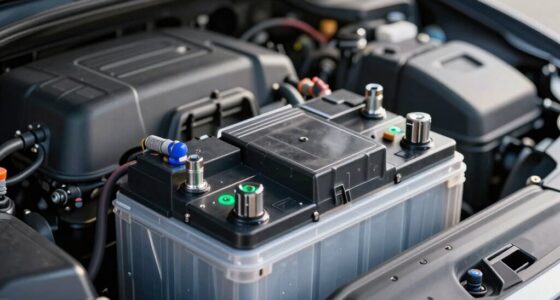
Using a multimeter to diagnose car electrical issues is straightforward. First, set your multimeter to measure DC voltage when checking batteries, and connect the probes to the terminals—your battery should read about 12.6 volts when off. For fuse checks, switch the multimeter to continuity mode to see if fuses are intact. Always turn off the vehicle before testing and follow safety tips. If you keep exploring, you’ll gain the skills to troubleshoot efficiently and confidently.

Get business pricing on garage and car supplies
- Business-only prices and quantity discounts
- Tax-exempt purchasing
- Multiple users, one account, clear invoices
Key Takeaways
- Use the multimeter to test battery voltage, ensuring it reads around 12.6 volts when the vehicle is off.
- Check fuses with the multimeter in continuity mode to identify blown or faulty fuses early.
- Measure voltage at the alternator to confirm it charges the battery properly during engine operation.
- Always turn off the vehicle before testing fuses or electrical components to avoid false readings or damage.
- Regularly use the multimeter to monitor electrical health, preventing breakdowns and ensuring vehicle reliability.

When troubleshooting car electrical issues, a multimeter becomes an essential tool you can’t afford to overlook. It allows you to efficiently diagnose problems by measuring voltage, current, and resistance, which are key to pinpointing faults. One of the first steps you’ll want to take is battery testing. A weak or dead battery can cause a host of electrical problems, from dim headlights to difficulty starting your engine. With your multimeter, set it to DC voltage and connect the probes to the battery terminals—red to positive and black to negative. A healthy, fully charged battery should read around 12.6 volts when the car is off. If your reading drops significantly below that, the battery might need replacing or recharging. Regular battery testing with your multimeter helps prevent unexpected breakdowns and ensures your car’s electrical system remains reliable.
Another critical aspect of troubleshooting involves fuse checking. Fuses act as safety devices, protecting your car’s wiring and electrical components from overloads. A blown fuse can interrupt power to vital systems, causing malfunctions or total failure of certain features. To perform fuse checking, first locate your vehicle’s fuse box, which is usually under the dashboard or in the engine compartment. Remove the suspect fuse and set your multimeter to continuity mode or the lowest resistance setting. Touch the probes to the fuse’s metal contacts; if the multimeter beeps or shows a reading close to zero, the fuse is good. If there’s no beep or the reading is infinite, the fuse is blown and needs replacement. Checking fuses regularly with your multimeter provides a quick way to identify electrical interruptions before they lead to more serious issues.
Using your multimeter for battery testing and fuse checking is straightforward once you get the hang of it. These procedures help you quickly narrow down the cause of electrical problems, saving you time and money. Remember, always ensure your vehicle is turned off when testing fuses to avoid false readings or potential damage to your multimeter. When testing the battery, it’s best to do it with the car off to get an accurate state-of-charge reading, but you can also check voltage while the engine runs to see how well the alternator charges the battery. Additionally, understanding the color accuracy of your multimeter can help ensure your readings are precise, especially when diagnosing complex electrical issues. With consistent use of your multimeter, you’ll gain a better understanding of your vehicle’s electrical health, making troubleshooting faster, safer, and more precise. In the end, mastering these simple tests empowers you to keep your car running smoothly and avoid costly trips to the mechanic.
digital multimeter for car diagnostics
As an affiliate, we earn on qualifying purchases.
As an affiliate, we earn on qualifying purchases.
Frequently Asked Questions
Can a Multimeter Detect Hidden Wiring Faults in a Car?
Yes, a multimeter can help you detect hidden wiring faults in a car. By testing continuity, voltage, and resistance, you can identify electrical faults that aren’t visible. You might need to probe behind panels or in concealed areas, so patience is key. While it won’t see every hidden wiring issue, a multimeter is a powerful tool to uncover many hidden wiring faults and keep your electrical system running smoothly.
How Do I Calibrate My Multimeter for Automotive Use?
To guarantee your multimeter provides reliable readings, start with proper calibration techniques. You can check multimeter accuracy by testing it against a known voltage source or a calibration tool. For automotive use, set your multimeter to the correct setting—volts, ohms, or amps—and compare its readings to the standard. Regularly calibrate it and verify accuracy to avoid misdiagnosis, keeping your electrical troubleshooting precise and trustworthy.
What Safety Precautions Should I Follow When Testing Car Electrical Systems?
When testing car electrical systems, always wear personal protective equipment like gloves and safety glasses to protect yourself from shocks or sparks. Make certain the circuit is isolated before testing to prevent accidental shorts or damage. Use insulated tools and avoid touching live wires. Keep your workspace dry and be cautious around battery terminals. Following these safety precautions helps you work safely and accurately diagnose electrical issues without injury.
Can a Multimeter Diagnose ECU Issues Directly?
Think of a multimeter as a flashlight in a dark room—helpful but limited. It can’t diagnose ECU issues directly because ECU diagnostics involve complex communication protocols and software analysis beyond basic readings. While a multimeter can check sensors and circuits influencing the ECU, it can’t pinpoint ECU faults itself. Remember, multimeter limitations mean you’ll need specialized diagnostic tools like an OBD-II scanner for accurate ECU troubleshooting.
How Long Does It Typically Take to Diagnose Electrical Problems With a Multimeter?
It usually takes about 30 minutes to an hour to diagnose electrical problems with a multimeter, depending on the testing complexity. Your diagnostic speed varies based on how familiar you are with the system and the issue’s complexity. For straightforward checks, you might finish quickly, but more complex problems require careful testing and patience. Stay methodical, and you’ll identify the issue efficiently without rushing.
As an affiliate, we earn on qualifying purchases.
Conclusion
By mastering your multimeter, you gain the power to diagnose, understand, and troubleshoot your car’s electrical issues with confidence. You identify problems quickly, save money efficiently, and guarantee safety reliably. You simplify complex circuits, clarify confusing readings, and take control of your vehicle’s health. With each test, you become more skilled, more prepared, more independent. Embrace the multimeter’s magic, and turn uncertainty into clarity, frustration into solutions, and maintenance into mastery.
As an affiliate, we earn on qualifying purchases.
As an affiliate, we earn on qualifying purchases.
Fall Picks
fall essentials
As an affiliate, we earn on qualifying purchases.