
TL;DR

Get business pricing on garage and car supplies
- Business-only prices and quantity discounts
- Tax-exempt purchasing
- Multiple users, one account, clear invoices
Wisconsin startup Hoffman EV displayed the Hoffman Badger, an 11-seat minibus built using hardware and software from a Tesla Model 3 or Model Y, at the SEMA show in Las Vegas. The company says it could offer other body styles, including a pickup, but production plans, price, range and a firm sales date have not been established.
Wisconsin startup Hoffman EV has displayed the Hoffman Badger, an 11-seat minibus built around hardware from a Tesla Model 3 or Model Y, at the SEMA show in Las Vegas. The company says the platform could support other body styles, including a pickup, but has not settled its production plan, final pricing, range or launch details.
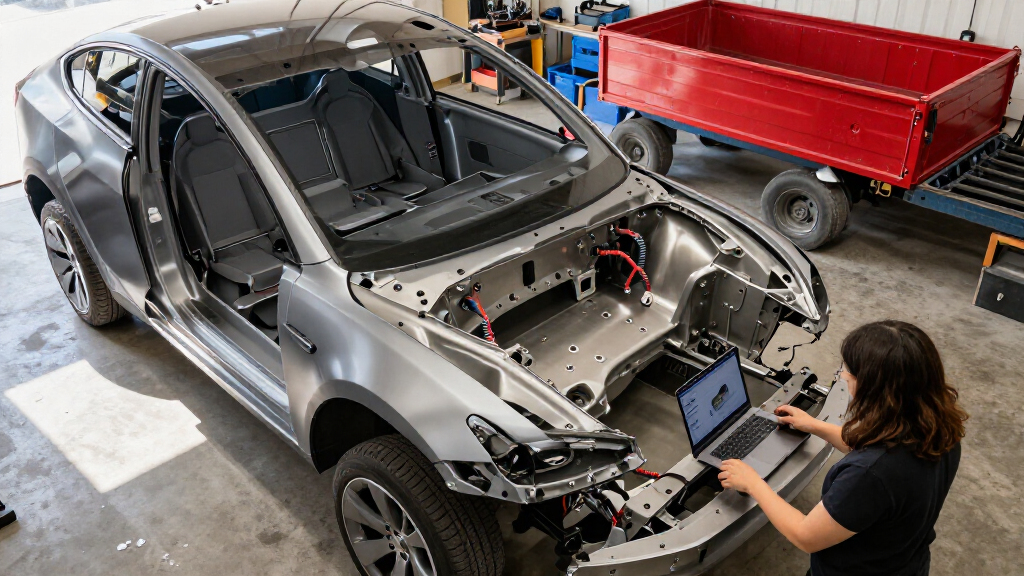
The Badger uses components from a donor Model 3 or Model Y, including the seats, dashboard, steering wheel, motors and door handles, according to Hoffman EV. Those parts are installed in a new chassis, with the high-voltage battery raised about 1.5 inches compared with the donor vehicles. The startup says the vehicle has eight inches of ground clearance. Its first example drove from the company’s Wisconsin base to SEMA and used Tesla Superchargers along the way, the report said.
The prototype is configured as an 11-seat bus, with removable doors, roof and most seats. Hoffman EV says it is designed to accept different body structures, or “top hats,” including a pickup form. The company says the Badger retains the donor Tesla’s hardware and software, allowing use of Superchargers and Tesla’s Full Self-Driving (Supervised) driver-assistance system. That description is the company’s claim; the report does not provide independent testing of the system in the Badger.
Hoffman EV says it could build about 100 vehicles per year, though the company has not finalized its near-term production plan. The Badger may be sold as a completed vehicle with a customer-selected body style or as a kit supplied with a VIN, in which case buyers would need to source a Model 3 or Model Y donor. The company expects pricing to fall between the Slate Truck and Tesla Cybertruck, a broad comparison that the report places at roughly $26,400 to $77,000. No Badger price has been announced.
A New Route for Older Teslas
The Badger proposes a different use for used or damaged Tesla vehicles: retain their electric drive components and cabin equipment while changing the chassis and body. If the concept reaches production, it could give Tesla owners or conversion businesses a way to repurpose donor cars rather than preserve their original shape. For buyers, the range of proposed configurations could include passenger transport and utility-style vehicles using familiar Tesla systems.
The practical case is still unproven. A minibus body can bring different energy use, passenger capacity and handling demands than a Model 3 or Model Y, while the source report provides no validated range, payload or safety test results. The announced capacity of about 100 vehicles annually is a company estimate, not evidence of an established manufacturing operation. The proposal matters as an unusual vehicle-conversion plan, but its commercial impact will depend on cost, certification, supply of donor cars and real-world performance.
Products Worth Considering

DEWALT 20V MAX 3-Tool Brushless Power Tool Combo Kit with Drill, Impact Driver, Oscillating Tool, 3 Batteries, and Charger (DCK360D3)

DEWALT 20V MAX 5-Tool Cordless Combo Kit with Drill, Impact Driver, Saws, Oscillating Multi-Tool, Batteries, Charger, and Bag (DCK551D1M1)

Chemical Guys 10-Piece Car Wash Kit with Foam Gun
As an affiliate, we earn on qualifying purchases.
How the Badger Uses Tesla Donors
Hoffman EV is a small Wisconsin company whose existing business focuses on converting older British vehicles to electric power. Its portfolio includes electric conversions of the DeLorean DMC-12, classic Volkswagen Beetles, Land Rovers, Rolls-Royce and Bentley models, according to the source report. The Badger extends that conversion approach by starting with a modern electric vehicle’s components and placing them in a substantially different structure.
The prototype was shown at SEMA in Las Vegas. Hoffman EV says the chassis and body use powder-coated aluminum, with stainless steel or corrosion-resistant coated fasteners. It also says the new materials are recycled except for some small 3D-printed parts. The company has described an aerodynamic update for the first quarter of 2027, but the report does not specify what changes that work will include or whether it will affect the production schedule.
“He did not have a precise short-term plan, and said attending SEMA would help identify what people actually want.”
— Geoffrey Hoffman, Hoffman EV founder, speaking in an Out of Spec Review video
Price, Range and Production Remain Open
Several details needed to judge the Badger as a purchase are not yet available. Hoffman EV has not announced an exact price, a confirmed sales date, a final production schedule or an estimated driving range. The source report says sales are expected to start next year, but the company’s founder also described its short-term plan as unsettled.
The company has offered competing indications about efficiency without publishing figures. The boxy shape could reduce highway range compared with the donor Model 3 or Model Y, while founder Geoffrey Hoffman said the lighter Badger might achieve more range around town. Those statements are projections, not measured results. The report also does not provide independent information on crash performance, regulatory approvals, passenger capacity certification or how the Tesla driver-assistance system performs after conversion.
Demand Will Shape the Launch Plan
Hoffman EV has said its SEMA appearance will help it learn which Badger configurations potential customers want. The company is expected to develop improved aerodynamics in the first quarter of 2027, according to the source report. It has not published a firm timetable for taking orders or starting deliveries.
Further updates would need to establish which body styles will be offered, whether buyers can choose between a completed vehicle and a kit, and how donor vehicles will be sourced. A firm price, tested range, production capacity and details about certification would help show whether the proposed 100-unit annual output can become a commercial product. Until those are disclosed, the Badger remains a demonstrated prototype and a company proposal rather than a fully specified vehicle on sale.
Key Questions
What is the Hoffman Badger?
It is a vehicle conversion concept from Wisconsin startup Hoffman EV. The example shown at SEMA is an 11-seat minibus built around components from a Tesla Model 3 or Model Y.
Will the Badger only be a minibus?
No. Hoffman EV says the platform could use different body styles, including a pickup. The company has not confirmed which versions will reach production or when.
How much will it cost, and when will it go on sale?
No final price or firm sales date has been announced. The company expects pricing between the Slate Truck and Cybertruck and has said sales could begin next year, but plans remain unsettled.
What is the Badger’s driving range?
Hoffman EV has not published an estimated range. The source report notes that the boxy shape could reduce range compared with the donor Tesla, while the founder suggested its lower weight might help in town; neither claim is supported by published test figures.
Can it use Tesla Superchargers and driver assistance?
Hoffman EV says the Badger retains the donor Tesla’s hardware and software, including Supercharger access and Full Self-Driving (Supervised). The report does not include independent verification of how those functions work in the converted vehicle.
Source: insideevs.com