Your GPS accuracy depends on satellite signals, environmental factors, and device quality. Tall buildings, dense foliage, and indoor spaces can block signals or cause reflections, leading to errors of several meters. Atmospheric conditions and poor satellite geometry also reduce precision. Modern technology uses multiple sources and algorithms to improve reliability, but obstacles still impact performance. If you want to understand what causes these errors and how to get better accuracy, there’s more to explore.
Key Takeaways
- GPS accuracy varies from a few meters outdoors to significantly less in urban canyons or indoor environments.
- Signal blockages, reflections, and multipath errors caused by buildings and dense foliage reduce positioning precision.
- Atmospheric conditions like ionospheric delays and weather interference can introduce signal delays and inaccuracies.
- Satellite geometry and placement impact signal quality; poor distribution increases location errors.
- Supplemental data sources like Wi-Fi and cell towers help improve GPS accuracy in challenging environments.
How GPS Works and Its Core Components
GPS, or Global Positioning System, relies on a network of satellites orbiting the Earth that constantly transmit signals. These satellites stay in precise satellite orbit, maintaining consistent positions to guarantee reliable coverage. Each satellite uses signal modulation to encode information, allowing your device to interpret the signals accurately. When your GPS receiver picks up a signal, it measures how long it took to arrive, calculating your distance from that satellite. By connecting signals from multiple satellites, your device triangulates your exact location. The core components of GPS include the satellites, which broadcast the signals, and your receiver, which decodes and processes them. This combination of satellite orbit stability and sophisticated signal modulation techniques forms the backbone of accurate navigation technology. Additionally, precise satellite orbit ensures the system’s reliability and accuracy in various conditions. Continuous advancements in satellite technology help improve positioning precision and system robustness over time, supported by ongoing system upgrades that enhance overall performance. Moreover, innovations in signal processing contribute to reducing errors and improving the reliability of GPS readings. Ongoing research into error correction methods further enhances the accuracy of positioning data under challenging environments.
Factors That Influence GPS Accuracy
Several factors can affect the accuracy of your GPS readings, often causing deviations from your true location. One key factor is gyroscope calibration; if your device’s gyroscope isn’t properly calibrated, it can lead to errors in motion tracking, especially during rapid movements or when GPS signals are weak. Additionally, user input accuracy plays a role—incorrectly entered addresses or preferences can misguide your steering. Environmental conditions, such as tall buildings or dense forests, can block satellite signals, further reducing accuracy. Device quality and settings also matter; outdated firmware or poor-quality hardware may struggle to process signals correctly. Understanding these factors helps you recognize when your GPS might be less reliable, so you can adjust your expectations and take extra precautions when navigating in challenging conditions. Proper calibration of your device’s sensors is essential for maintaining optimal navigation accuracy in various environments.
Common Sources of GPS Errors
You might notice GPS inaccuracies when signals are blocked by tall buildings or dense forests. Atmospheric conditions, like heavy clouds or solar activity, can also disrupt signal quality. Additionally, your device’s hardware limitations can introduce errors, especially if it’s outdated or damaged.
Satellite Signal Obstruction
Satellite signal obstruction occurs when physical barriers block or weaken the signals transmitted between satellites and your device, leading to inaccuracies in positioning. This issue, known as signal blockage, can cause your GPS to lose accuracy or even temporarily fail. Common sources include:
- Tall buildings or urban canyons – create satellite shadowing, where buildings block signals.
- Dense forests or thick foliage – weaken signals through signal attenuation.
- Bridged or indoor environments – limit satellite visibility, reducing accuracy.
These obstructions interfere with the direct line of sight needed for precise positioning. When signals are obstructed or shadowed, your device may rely on weaker signals, leading to errors. Recognizing these obstacles helps you understand why your GPS might sometimes be off. European cloud solutions can enhance navigation systems by integrating more reliable data sources and improving signal processing in challenging environments.
Atmospheric Interference Effects
Atmospheric interference can considerably impact GPS accuracy by disrupting the signals as they travel through the Earth’s atmosphere. Ionospheric delays occur when charged particles in the ionosphere slow down signals, causing timing errors. Tropospheric refraction results from water vapor and temperature variations bending the signals, leading to positional inaccuracies. These effects are unpredictable and vary with weather conditions, making precise navigation challenging. To better understand these influences, consider the following factors: Free Floating, and the ionosphere’s conditions can change rapidly, affecting signal transmission. Additionally, support for various environments can influence how atmospheric effects impact GPS signals. Incorporating advanced correction methods can help mitigate some of these errors and improve overall accuracy. Understanding the dynamic nature of atmospheric conditions is essential for improving navigation precision under different weather scenarios.
Device Hardware Limitations
Device hardware limitations are a common source of GPS errors that can compromise positioning accuracy. Your device’s sensors, such as accelerometers and gyroscopes, rely on proper hardware calibration to function correctly. When these sensors aren’t calibrated well, your device may provide inaccurate location data. Here are key issues to watch for:
- Sensor Drift: Over time, device sensors can lose calibration, leading to incorrect readings.
- Hardware Aging: Wear and tear can degrade sensor performance, affecting GPS accuracy.
- Manufacturing Variances: Differences in device sensor quality may cause inconsistencies in location data.
Regularly calibrating your device’s sensors helps minimize these hardware-related errors, ensuring more accurate navigation.
Satellite Geometry and Signal Quality

Since the arrangement of satellites in the sky directly impacts signal reception, understanding satellite geometry is essential for navigation accuracy. When satellites are well-spread out, your device receives better signal quality, reducing errors. Poor satellite geometry, like satellites clustered together, weakens the signal and increases positional inaccuracies. Good satellite geometry ensures strong, reliable signals, while poor geometry can cause delays or inaccuracies. Additionally, the forage and supplies available, such as lard and cattle breeds, can influence your preparedness for navigation disruptions. Maintaining awareness of satellite positions and the importance of wave and wind conditions can help you understand potential errors in your navigation system. Proper signal quality is crucial for precise positioning, especially in challenging environments. Understanding the satellite constellation can further improve your comprehension of GPS accuracy and troubleshoot issues effectively.
The Impact of Urban Environments and Obstacles
Urban environments pose significant challenges to navigation systems, as tall buildings can block signals and cause data gaps. Reflection and multipath errors occur when signals bounce off surfaces, leading to inaccurate positioning. Additionally, urban canyon effects narrow the sky view, making it harder for your device to maintain a reliable connection. Techniques such as advanced signal processing help mitigate some of these issues and improve accuracy. Implementing multi-constellation receivers can also enhance signal reception in complex settings. Furthermore, integrating real-time correction data can significantly reduce positioning errors caused by environmental factors. Employing robust algorithms that adapt to signal disruptions is essential for maintaining precise navigation in these challenging conditions. Incorporating environment-aware filtering methods allows devices to better distinguish between true signals and multipath errors, further improving reliability.
Signal Blockage Challenges
Guiding through dense cityscapes can be particularly challenging because tall buildings and numerous obstacles often block signals, disrupting communication between your device and GPS satellites. To combat this, modern navigation systems use interference mitigation techniques to reduce signal loss. They also employ signal prioritization to focus on the strongest, most reliable signals available. Here are some key strategies:
- Dynamic signal selection to adapt to changing environments.
- Combining data from multiple satellites for better accuracy.
- Using supplemental sources like Wi-Fi or cell tower signals when GPS signals weaken.
Additionally, understanding how different materials affect signals can help optimize device placement and reception. These methods help maintain navigation accuracy despite urban signal blockages. By emphasizing interference mitigation and signal prioritization, your device can better navigate through obstacles, ensuring you stay on course even in challenging environments.
Reflection and Multipath Errors
Reflection and multipath errors pose significant challenges for navigation systems in environments filled with obstacles. When signals bounce off buildings, windows, or other surfaces, reflection errors occur, causing the GPS receiver to misinterpret the signal’s true path. Multipath errors happen when multiple signals arrive at your device from different paths, confusing the receiver about your exact location. These errors can lead to position inaccuracies, sometimes by several meters, especially in urban areas with dense structures. You might notice your device showing slight deviations or jittery movements. To mitigate these issues, many modern GPS units incorporate algorithms that filter out reflected signals and focus on direct paths. Understanding how reflection and multipath errors influence your navigation helps you interpret your device’s data more accurately in challenging environments.
Urban Canyon Effects
Moving through city streets can be challenging because tall buildings and narrow alleyways create a complex environment for GPS signals. This phenomenon, known as the urban canyon effect, often causes accuracy issues. Skyscraper interference blocks or reflects signals, leading to errors. To understand this better:
- Signals bounce off buildings, creating multipath errors that send your device false location data.
- Narrow streets limit satellite visibility, reducing the number of signals your GPS can access.
- Tall structures physically obstruct signals, causing delays or complete loss of connection.
These factors make navigation tricky in dense urban areas. Your GPS relies on satellite signals, but in an urban canyon, skyscraper interference and signal reflection can profoundly impact accuracy, leaving you slightly off-course.
Signal Disruptions and Environmental Interferences

Environmental factors and signal disruptions can considerably impair navigation systems, causing inaccuracies or complete failures. Signal jamming and environmental interference, like dense forests or tall buildings, disrupt satellite signals. These interferences may lead to delayed positioning updates or errors in your device’s readings. To combat this, interference mitigation techniques help reduce signal noise and improve reliability.
| Cause | Effect | Mitigation |
|---|---|---|
| Signal jamming | Loss of signal accuracy | Use encrypted or resilient signals |
| Urban canyons | Signal reflection and delays | Incorporate multi-constellation data |
| Dense foliage | Signal weakening | Rely on augmented systems |
| Weather conditions | Signal interference | Use sensor fusion for accuracy |
Methods to Improve Your GPS Precision
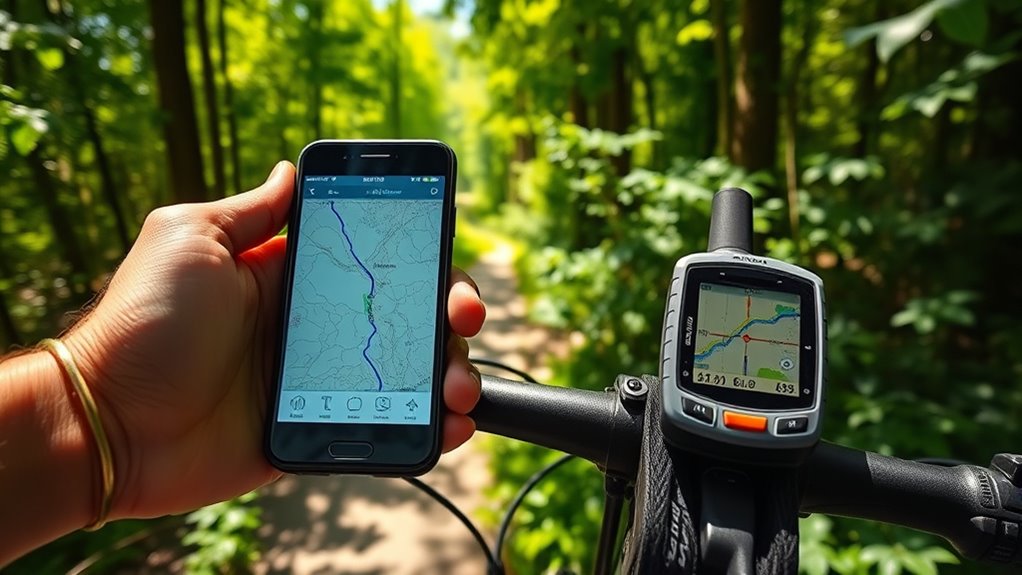
Improving your GPS precision is essential for reliable navigation, especially in challenging environments. To enhance accuracy, start with map calibration—regularly update and verify your maps to guarantee they match real-world conditions. Next, explore alternative positioning methods such as Wi-Fi triangulation or cell tower data to supplement GPS signals when they’re weak. Additionally, consider using external GPS receivers or differential GPS devices that correct signal errors in real-time. These tools help reduce inaccuracies caused by environmental factors and signal disruptions. By calibrating your maps and integrating alternative positioning techniques, you can markedly improve your navigation reliability. Remember, combining multiple methods ensures better precision, especially in dense urban areas or remote regions where typical GPS signals may falter.
Interpreting GPS Data and Recognizing Inaccuracies

Understanding how to interpret GPS data is crucial for accurate navigation, especially when signals are unreliable. First, check for map calibration issues; if your map isn’t aligned correctly with real-world geography, your position may seem off. Always verify your location against known landmarks or nearby features. Be mindful of user input errors, like incorrect destination points or misplaced waypoints, which can lead to confusion. Recognize inaccuracies by looking for sudden jumps or inconsistencies in your data, often caused by signal interference or multipath errors. If your GPS shows unlikely movement speeds or positions, consider recalibrating your device or updating map data. By understanding how to read these signals and recognizing potential errors, you can make better decisions and improve your navigation accuracy.
Frequently Asked Questions
How Does GPS Accuracy Vary Between Different Devices?
Your GPS accuracy varies between devices because it depends on their device sensors and signal triangulation. Some smartphones have advanced sensors that improve precision, while basic models might rely solely on satellite signals, making them less accurate. External factors like tall buildings or dense forests can also interfere with signal triangulation, causing discrepancies. So, your device’s hardware and environmental conditions directly impact how accurate your GPS navigation will be.
Can Weather Conditions Affect GPS Signal Reliability?
Weather interference can definitely impact your GPS signal, especially during heavy rain or snow. While it’s not as dramatic as losing signal entirely, it causes signal attenuation, making your device less precise. Imagine trying to navigate through fog—you get the idea. Storms, clouds, and atmospheric conditions can weaken satellite signals, reducing accuracy. So, don’t rely solely on GPS in severe weather; stay aware of potential disruptions and keep backup navigation options handy.
Do All GPS Systems Use the Same Satellites and Signals?
No, not all GPS systems use the same satellites and signals. You’ll find different satellite constellations, like GPS (U.S.), GLONASS (Russia), Galileo (Europe), and BeiDou (China), each with unique satellite networks. These systems use varied signal modulation techniques to transmit data, which can affect accuracy and reliability. So, depending on your device, it might access different constellations, impacting how precisely your location is determined.
How Often Should I Update My GPS Software for Better Accuracy?
You should update your GPS software regularly, ideally every few months, to guarantee better map accuracy. Software updates fix bugs, add new features, and improve navigation precision. By keeping your GPS up-to-date, you reduce errors caused by outdated maps or software glitches. Check for updates through your device’s settings or app store, and install them promptly to experience the most accurate routing and location data possible.
Can GPS Errors Impact Critical Navigation for Emergency Services?
GPS errors can be like a shadow lurking in crucial moments, impacting emergency services. You might not see satellite timing issues or signal multipath, but they can cause location inaccuracies. These errors may delay response times or misdirect responders, making precise navigation essential. Regular updates and advanced technology help minimize risks, ensuring emergency teams stay on course when every second counts. Your safety depends on keeping systems accurate and reliable.
Conclusion
Understanding how GPS works and its potential errors is like having a map through a foggy night—you’ll navigate better once you know what clouds the signal. While no system is perfect, being aware of factors like urban obstacles or satellite positions helps you stay on course. Think of your GPS as a helpful compass, not a crystal ball—use it wisely, and you’ll find your way with confidence despite the occasional hiccup.