
TL;DR

Get business pricing on garage and car supplies
- Business-only prices and quantity discounts
- Tax-exempt purchasing
- Multiple users, one account, clear invoices
Automotive diagnostic scan tools communicate with vehicle systems to retrieve fault codes, display live data, and perform tests. The right tool depends on your needs—whether basic code reading or advanced programming—especially as vehicles grow more complex with electrification and cybersecurity.
What Exactly Do Automotive Diagnostic Scan Tools Do?
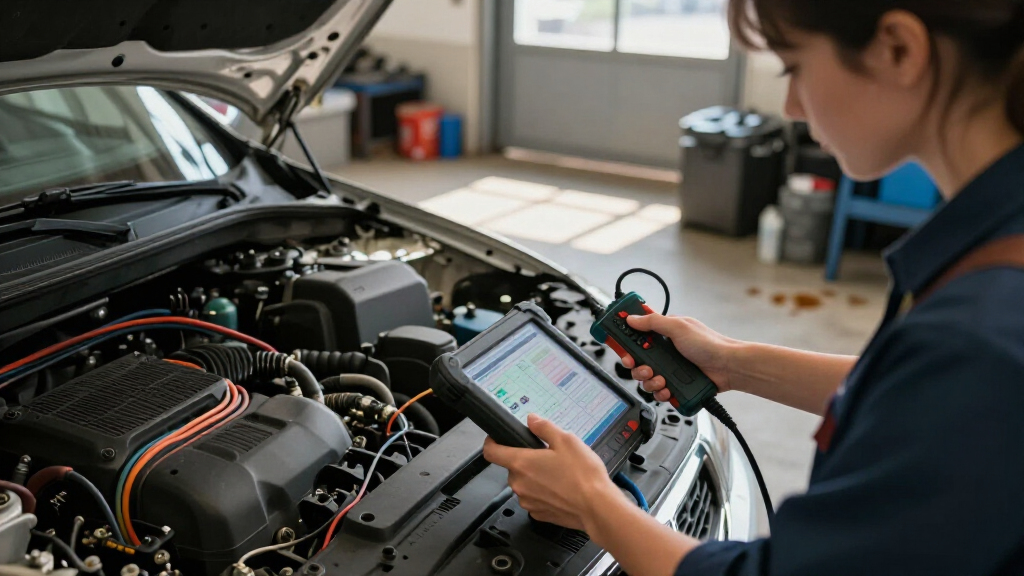
At their core, automotive diagnostic scan tools act as interpreters for your vehicle’s electronic control modules (ECMs). They connect via the OBD-II port—usually tucked under the dashboard near your left knee—and retrieve data. But their job doesn’t stop at just reading engine codes. The best tools can display real-time sensor readings, test individual components, reset maintenance alerts, and even reprogram modules.
Imagine you’re troubleshooting a stubborn engine misfire. A basic code reader might tell you there’s a ‘P0300’ random misfire code. But a more advanced scan tool can show live data from spark plugs, injectors, and sensors, helping you pinpoint whether the coil, fuel injector, or spark plug is at fault. These insights save you from replacing parts blindly or guesswork that costs money and time.
Understanding why these capabilities matter is crucial. Real-time data allows you to see exactly how sensors behave during operation, revealing issues that static codes can’t pinpoint. Active testing can confirm whether a component is functioning correctly, reducing guesswork. The ability to reprogram modules or reset adaptations can also fix issues without dealer intervention, saving money and time. However, these advanced features often come with a learning curve and higher costs, so knowing what you need helps you choose the right tool for your skill level and vehicle complexity.
As an affiliate, we earn on qualifying purchases.
Different Types of Scan Tools and What They Can Do for You
Not all scan tools are created equal. Here’s a quick rundown of the main categories:
- Basic code readers: Just read and clear engine trouble codes. Perfect for quick checks or beginners.
- Consumer OBD-II scanners: Add live data, freeze-frame snapshots, and readiness monitors. Great for DIYers who want more info.
- All-system scanners: Access multiple modules like airbags, ABS, transmission, and climate control. Think of them as the Swiss Army knives of diagnostics.
- Bidirectional scan tools: Send commands to components—like cycling an ABS pump or opening a throttle. Critical for active testing and calibration.
- Professional diagnostic platforms: Offer comprehensive features including wiring diagrams, coding, and broad vehicle coverage. Used by repair shops.
- OEM diagnostic systems: Provide factory-level access, including proprietary functions and programming support.
Choosing the right type depends on your needs and technical skill. For instance, a basic code reader might suffice for occasional DIY fixes, but if you’re working on complex systems or high-end vehicles, investing in a bidirectional or professional platform can vastly improve diagnostic accuracy. These advanced tools allow you to perform active tests—such as cycling the ABS pump or activating relays—which can confirm faults more definitively. This depth of diagnostic capability reduces unnecessary repairs and helps ensure that the real problem is addressed the first time.
professional automotive code reader
As an affiliate, we earn on qualifying purchases.
As an affiliate, we earn on qualifying purchases.
Why Your Car’s Fault Codes Only Tell Half the Story
Diagnostic trouble codes (DTCs) like P0171 or B0020 are vital clues, but they’re not the full diagnosis. These codes point to a problem detected by the vehicle’s sensors or modules, but they don’t specify the exact part or root cause. For example, a code indicating ‘Engine Misfire’ could be caused by spark plugs, coils, fuel injectors, or even wiring issues.
Additionally, codes can be pending, confirmed, or history—each tells a different story about the fault’s current status. Clearing codes might turn off the warning light temporarily, but it won’t fix the problem. If the underlying issue remains, the warning will return after a few drive cycles.
This highlights why comprehensive diagnostics are essential. Modern scan tools don’t just read codes—they also display live sensor data, help interpret what causes the fault, and guide you through testing individual components. This deeper level of analysis reduces guesswork, prevents unnecessary part replacements, and ensures that you address the actual root cause rather than just the symptom. Relying solely on fault codes can lead to misdiagnosis, unnecessary expenses, and recurring problems, especially as vehicles become more integrated and complex.
As an affiliate, we earn on qualifying purchases.
Features That Make a Scan Tool Worth the Investment
When shopping for a scan tool, certain features can make or break its usefulness. Here’s what you should look for:
- Vehicle compatibility: Supports your car’s make, model, and year. Check if it supports modules like ABS, airbags, or hybrid systems.
- Live data and graphing: Visualize sensor readings in real-time—helping you spot anomalies quickly.
- Bidirectional testing: Send commands to components—like activating a cooling fan or cycling brakes—to diagnose control issues.
- Module coding and programming: For advanced repairs, support for reprogramming modules can mean fewer trips to the dealer.
- Wireless connectivity: Bluetooth or Wi-Fi can make diagnostics more convenient, especially with mobile apps.
- Update policy and support: Regular updates ensure compatibility with newer vehicles and features. Check if updates are free or subscription-based.
Choosing a scanner with these features means investing in a tool that grows with your needs. For example, bidirectional testing is invaluable for active diagnostics, but it’s usually found on more advanced models. Similarly, module coding support can be a game-changer for modern vehicles with complex electronic systems. Always verify that the scanner supports your specific vehicle makes and models, as incompatibility can limit functionality. Remember, a feature-rich scanner can save you money and time by enabling more precise diagnostics and repairs, especially as vehicle technology continues to evolve rapidly.
all-system vehicle diagnostic scanner
As an affiliate, we earn on qualifying purchases.
As an affiliate, we earn on qualifying purchases.
What’s Changing in the World of Automotive Scanners?
New tech is reshaping how scan tools work and what they can do. Here’s what’s on the horizon:
- Secure gateways: More manufacturers lock down systems with security gateways, making some functions only accessible with paid subscriptions or OE tools.
- CAN FD and Ethernet: Vehicles are shifting from traditional CAN to faster networks like CAN FD and Ethernet-based DoIP. Older adapters might struggle to communicate properly.
- Electric and hybrid vehicle diagnostics: Tools are expanding beyond combustion engines to include batteries, inverters, and charging systems—though high-voltage work needs safety training.
- ADAS calibration: Advanced driver-assistance systems need precise calibration after repairs. Some scanners can put these systems into calibration mode, but many require specialized equipment and conditions.
- Remote diagnostics: Cloud-based platforms enable remote support, shared diagnostics, and vehicle health tracking—saving time and increasing accuracy.
These advancements reflect the industry’s move toward more connected and electrified vehicles. As security measures tighten, expect more subscription-based models and OEM-specific tools. The adoption of faster data networks like CAN FD and Ethernet will improve data transfer speeds and diagnostic capabilities, but may require newer adapters and software updates. The rise of electric and hybrid vehicles demands new diagnostic skills and tools capable of high-voltage safety and specialized testing. Meanwhile, features like ADAS calibration and remote diagnostics are making vehicle repair more precise and efficient, but also more complex. Staying informed about these trends helps you choose tools that won’t become obsolete and ensures you’re prepared for the vehicles of tomorrow.
Limitations and Risks You Should Know About
Not every scanner does everything. Cheap adapters may disconnect, provide inaccurate data, or even damage your vehicle’s modules. Some functions—like module programming or active testing—require stable power supplies, proper training, and correct procedures.
Also, clearing codes without fixing the root cause can be risky. It might hide symptoms temporarily but won’t solve the problem. And with security gateways tightening, some functions may require OEM accounts or subscriptions—adding cost and complexity.
Be cautious with wireless tools. They can drain batteries, pose security risks, or be unreliable during critical tests. Always follow the manufacturer’s instructions and use trusted equipment for high-voltage or safety-critical systems.
It’s important to understand that not all scan tools are created equal. Cheaper models often lack the depth and reliability needed for serious diagnostics and can even cause harm if used improperly. For critical repairs—especially involving high-voltage systems like hybrids or EVs—professional-grade tools and proper safety training are essential. Additionally, wireless tools may introduce security vulnerabilities; hackers can potentially access your vehicle’s data or control systems if the device isn’t secured properly. Always prioritize quality, compatibility, and safety to avoid costly mistakes or damage to your vehicle’s systems.
Your Most Common Questions About Automotive Scan Tools, Answered
What’s the difference between a code reader and a scan tool?
A code reader typically only retrieves and clears engine trouble codes. A scan tool can access multiple modules, display live data, perform active tests, and sometimes reprogram modules, making it far more versatile.
Will any OBD-II scanner work on my car?
Basic scanners that support standard OBD-II protocols will read emissions-related codes on most compliant vehicles. But for manufacturer-specific functions or modules like airbags, ABS, or hybrid systems, you’ll need a more advanced or dedicated scanner.
Can a scan tool tell me exactly what part to replace?
Usually not. It reports a fault detected by the vehicle’s control system, but the actual cause could be wiring, sensors, or mechanical issues. It’s a starting point, not a definitive diagnosis.
Is it safe to leave a scan tool plugged in?
Many adapters support low-power modes, but some draw power continuously or pose security risks. Check the manufacturer’s recommendations to avoid draining your battery or exposing your vehicle to hacking risks.
Can a scanner fix or program a new module?
Some professional tools can program modules or register new keys. But support varies by vehicle and requires proper licensing, subscriptions, and sometimes online authentication. It’s not a DIY plug-and-play process.
Addressing the most common questions with clarity helps users understand the capabilities and limitations of diagnostic tools. Knowing the difference between a basic code reader and a full-featured scan tool guides proper purchasing decisions. Recognizing that not all scanners support every vehicle or function prevents disappointment and misdiagnosis. Safety considerations—like leaving a device plugged in or attempting module programming—are crucial for avoiding damage or security breaches. Providing accurate, practical answers empowers users to make informed choices and use their tools effectively.
Fall Picks
fall essentials
As an affiliate, we earn on qualifying purchases.