
TL;DR

Get business pricing on garage and car supplies
- Business-only prices and quantity discounts
- Tax-exempt purchasing
- Multiple users, one account, clear invoices
In the early 1900s, some electric-car makers marketed their vehicles to women, emphasizing that they were easier to start and quieter than gasoline cars. Fannie Goodnow’s 1908 Bailey Victoria Phaeton offers a documented example of an early owner and the charging technology behind her car. The account is a historical report, not news of a current product launch or policy change.
Early electric-car makers marketed their vehicles to women by emphasizing their quiet operation and simple starting process, according to an IEEE Spectrum report on the first decades of automobile manufacturing. The account also documents Fannie Goodnow, an early electric-car owner whose 1908 Bailey Victoria Phaeton used a household charging system based on a mercury-arc rectifier.
At the turn of the 20th century, electric cars competed with steam-powered and gasoline vehicles, and the market had not settled on a dominant technology. IEEE Spectrum reports that the number of U.S. carmakers rose from about 50 in 1898 to roughly 250 a decade later. Annual vehicle production increased from 7,000 in 1901 to 181,000 in 1910, amid fast growth and experimentation.
Electric cars had practical selling points in that contest. Before the electric starter arrived in 1911, drivers generally had to crank gasoline engines by hand; those engines were noisy and produced exhaust. Electric cars could be started by switching on the battery and did not emit exhaust while operating. Manufacturers used those differences in marketing aimed at women. General Electric advertisements showed stylishly dressed women plugging in cars and posing beside charging equipment. The report says electric cars were also promoted to doctors, who could make night calls without waking neighbors.
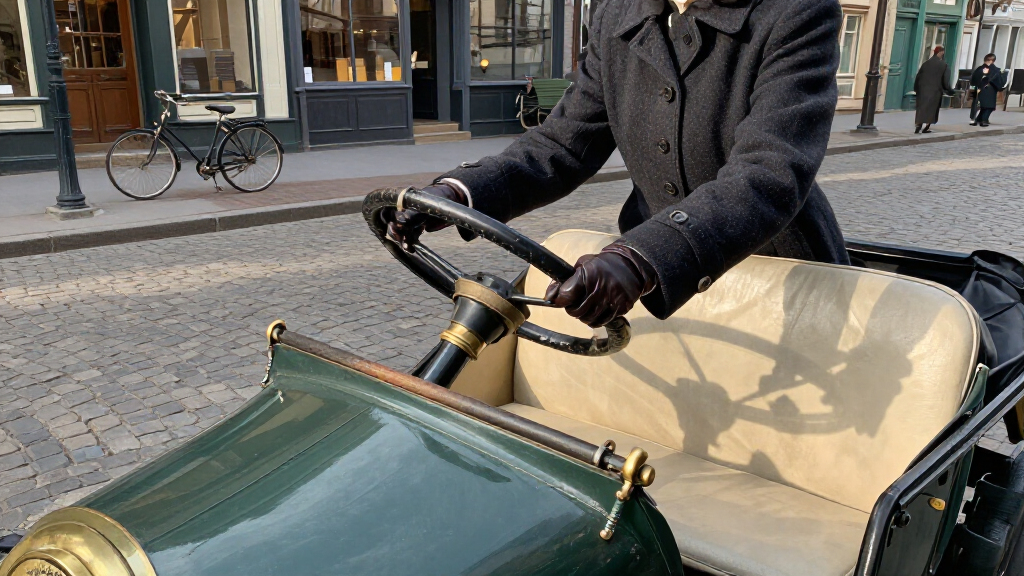
Goodnow owned a 1908 Bailey Victoria Phaeton, an open, two-seat electric car made by S.R. Bailey & Co. in Amesbury, Massachusetts. She charged it with a General Electric mercury-arc rectifier. The device converted alternating current from the power grid into the direct current needed by the car’s battery; a depleted battery took about 12 hours to charge, according to the report. Goodnow’s car used a 30-cell lead-acid battery mounted beneath the chassis, with a reported standard range of 64 to 80 kilometers. A larger battery was available at extra cost.
What Early EV Marketing Reveals
The history complicates the idea that electric vehicles have always been designed and promoted for a single type of driver. In the early market, their quietness and ease of starting were framed as advantages for women, while the same characteristics served other customers, including physicians. These were marketing choices shaped by the period’s technology and social assumptions, not evidence that electric cars were exclusively driven by women.
The account also shows that a vehicle’s appeal depended on more than its motor. Buyers had to weigh charging time, battery performance and access to electricity against the inconvenience of starting and operating gasoline cars. The history is relevant to present-day discussions of electric vehicles because it illustrates how perceptions of usability and charging infrastructure have long influenced adoption. It does not, by itself, establish a direct comparison with modern vehicles or explain the choices of today’s buyers.
Products Worth Considering

DEWALT 20V MAX 1/4-Inch Impact Driver Kit with Battery and Charger (DCF787D1)

Chemical Guys 14-Piece Arsenal Builder Car Wash Kit with Foam Blaster

Chemical Guys HOL123 Car Cleaning Kit – 14-Item Interior & Exterior Detailing Set
As an affiliate, we earn on qualifying purchases.
Bailey’s Shift From Carriages
S.R. Bailey & Co. began as a carriage and sleigh business. Galen Handy, who maintains the Early Electric Vehicles website, says founder Samuel Robinson Bailey built a reputation as an inventor and that one of the company’s carriages won a gold medal at the 1893 World’s Columbian Exposition in Chicago. The exposition included the Morrison electric wagon, which carried visitors and dignitaries around the grounds. As motor vehicles began challenging carriage makers, Bailey’s company announced in December 1906 that it would enter the electric-car business.
The company’s first Victoria Phaeton used an alkaline battery developed by Thomas Edison. Edison had promoted his battery as a better option for automobiles, but it leaked and failed to hold a charge, according to the report. Bailey later switched to batteries from Gould Storage Battery Co. Edison had improved his design by 1910, but the Model T, introduced by his friend Henry Ford, was helping gasoline cars gain ground. Meanwhile, the Bailey car’s charging apparatus illustrates how early electric ownership relied on dedicated equipment and long charging periods.
The charging device used technology associated with electrical engineer Peter Cooper Hewitt, who is generally credited with inventing the mercury-arc rectifier. The report describes the unit as using mercury vapor in a glass tube to direct current flow. Patents by Percy H. Thomas advanced Hewitt’s designs, and Thomas was chief electrician at Cooper Hewitt Electric Co., a company Hewitt cofounded with George Westinghouse.
“You just turned on the main battery switch, often with a key.”
— IEEE Spectrum report
What Goodnow’s Records Show
The account does not establish why Goodnow chose an electric car, how often she drove it, or how she used it day to day. It says she was a well-to-do woman in the Boston area and that several automobile producers were available to her, but the reason behind her purchase remains undocumented in the records consulted by the report’s author.
The material also does not quantify how widely electric cars were marketed to women or how buyers responded to those advertisements. The examples show that some manufacturers used gendered advertising; they do not establish that women made up most electric-car owners. The source is a historical account, and it reports no current industry development or forthcoming policy change.
The Historical Record Ahead
No new product release, investigation or policy action is announced in the source material. The next step for readers seeking more detail is to consult the underlying historical records and collections identified by the report, including material on Bailey vehicles, General Electric charging equipment and Goodnow’s car. The account itself leaves open whether additional documents might clarify her ownership and use.
For now, the documented record supports a narrower conclusion: early electric vehicles competed in a mixed technology market, some makers targeted women in their advertising, and Goodnow owned a Bailey electric car that required a lengthy charge. Further claims about how typical her experience was would require additional evidence.
Key Questions
Why were early electric cars marketed to women?
Manufacturers highlighted that electric cars were quieter and easier to start than gasoline cars, which usually required a hand crank before the electric starter was introduced in 1911. The marketing reflected the era’s assumptions about customers; it does not mean electric cars were made only for women.
Who was Fannie Goodnow?
Goodnow was an early electric-car owner. She owned a 1908 Bailey Victoria Phaeton and charged it with a General Electric mercury-arc rectifier, according to the IEEE Spectrum report.
How long did charging Goodnow’s car take?
The report says the charging unit took about 12 hours to charge a drained battery. Goodnow’s car used a 30-cell lead-acid battery with a reported standard range of 64 to 80 kilometers.
Why did Bailey move from carriages to electric cars?
The company entered electric-vehicle manufacturing as the carriage industry was declining. S.R. Bailey & Co. announced its move into electric vehicles in December 1906, according to the report.
Is this report about a current electric-car announcement?
No. It is a historical account of early electric vehicles, their marketing and charging technology. The supplied source does not describe a current product launch or policy development.
Source: spectrum.ieee.org