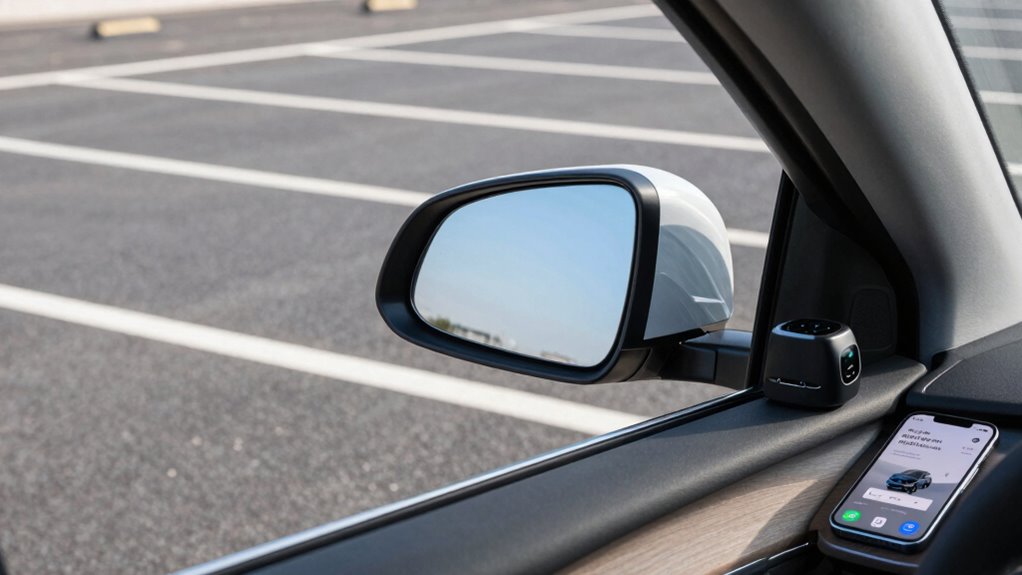
To boost your parking confidence without upgrading your car, focus on practicing in different environments to become more familiar with your vehicle’s size and turning capabilities. Use mirrors and check blind spots carefully, making small adjustments for accuracy. Choose spacious, well-lit spots to build your skills in less stressful settings. Over time, consistent practice and patience will improve your precision and ease. Keep exploring these techniques, and you’ll see your confidence grow steadily.
Key Takeaways
- Practice parking regularly in various environments to build familiarity and confidence.
- Use mirrors and sensors effectively to improve spatial awareness during maneuvers.
- Focus on slow, controlled movements and small adjustments for precise parking.
- Learn your vehicle’s dimensions and turning radius to select suitable parking spots.
- Follow parking lot etiquette to reduce stress and increase safety during parking.

Parking can be intimidating, but with a few simple strategies, you can boost your confidence behind the wheel. One of the best ways to do this is by understanding parking lot etiquette. Knowing how to navigate busy parking lots smoothly helps you avoid awkward maneuvers and keeps everyone safe. For example, always yield to pedestrians, signal your intentions, and be mindful of other drivers. When parking, avoid blocking aisles or entrances, and be respectful of those trying to find a space. Following these rules not only makes parking easier but also builds your confidence as you show respect for other drivers and pedestrians.
Another key to improving your parking confidence is mastering parking space selection. Instead of feeling pressured to squeeze into tight spots, look for spaces that give you plenty of room to maneuver. Choosing a spot that’s spacious enough allows you to park more comfortably and reduces the risk of hitting nearby cars or curbs. When scanning for a parking space, consider the overall layout—aim for spots that are well-lit, close to your destination, and away from high-traffic areas. This makes parking less stressful and gives you a better sense of control. Additionally, understanding vehicle dimensions can help you better judge whether a space is suitable, especially in tight areas. Becoming familiar with your vehicle’s turning radius can also improve your ability to navigate tight turns and parking maneuvers with greater ease.
As you practice parking, don’t be afraid to take your time. Rushing can lead to mistakes and increase anxiety. Instead, approach each parking situation with patience and focus. Use your mirrors and check your blind spots before moving, and take small, controlled adjustments to align your vehicle properly in the space. Over time, these habits become second nature and help you park with more precision and confidence. Remember, it’s okay to redo your parking if needed; better to take a moment and get it right than to rush and feel unsure. Building familiarity with your vehicle’s size and capabilities can also help you park more confidently, especially when you understand your car’s dimensions and turning radius. Practicing in different environments also helps you adapt to varying parking conditions and improves overall parking skills, further boosting your confidence.

ELSNU Backup Parktronic System Car Auto Vehicle Reverse with 8 Parking Sensors kit Distance Detection LCD Distance Display Sound Warning …
1: When reversing, 4 sensors at the back and 2 at the left and right corners in front…
As an affiliate, we earn on qualifying purchases.
As an affiliate, we earn on qualifying purchases.
Frequently Asked Questions
Can Parking Sensors Damage My Vehicle’s Paint?
Parking sensors generally won’t damage your paint if you maintain them properly. They’re designed to be non-invasive, but it’s smart to guarantee paint protection around sensor areas. Regular sensor maintenance keeps them functioning well and prevents debris from scratching your paint. If you notice anything unusual, clean the sensors and check for damage. Proper care helps avoid paint damage and keeps your sensors working effectively, boosting your parking confidence.
Are There Specific Parking Techniques for Tight Spots?
You’ll find that mastering parallel parking and angle parking can boost your confidence in tight spots. Start by aligning your mirrors, then turn sharply into parallel spaces, using your rearview mirror to gauge distance. For angle parking, approach at a slight angle, straighten the wheel once inside, and adjust as needed. Practice these techniques slowly, and soon, tight parking will feel more natural and less stressful.
How Often Should I Calibrate My Parking Assist System?
You should calibrate your parking assist system regularly, ideally every six months or after any sensor impacts or repairs. Proper sensor calibration guarantees your parking assist system accurately detects obstacles, improving your confidence in tight spots. Keep an eye on sensor performance—if it becomes inconsistent or alerts seem off, it’s time to recalibrate. Regular maintenance of your sensor calibration keeps your parking assist dependable and helps prevent parking mishaps.
Do Aftermarket Cameras Affect My Car’s Warranty?
Imagine adding aftermarket accessories like a new camera, transforming your parking view from blurry to crystal clear. Generally, aftermarket cameras shouldn’t void your warranty coverage if they’re properly installed and don’t interfere with your car’s systems. However, some manufacturers remain strict, so always check your vehicle’s warranty details or consult the dealer before installing aftermarket parts. This way, you protect your investment while enhancing your parking confidence.
What’s the Best Way to Practice Parking Safely?
Practice makes perfect when it comes to parking safely. Start with empty lots to master parallel parking and angle parking without pressure. Use cones or markers to simulate parking spots, gradually increasing difficulty. Focus on smooth steering and accurate positioning. Consistent practice builds your confidence, helping you handle real-world situations better. Remember, patience and repetition are key to becoming a skilled parker, whether parallel or angle.

JOYTUTUS Rear View Mirror, Universal 11.81 Inch Panoramic Convex Interior Clip-on Wide Angle Mirror to Reduce Blind Spot Effectively for Car SUV Trucks -Clear
【WIDER VIEW, MORE SAFE】: This convex rearview mirror provides you with a wider-angle view and perfect vision. 1….
As an affiliate, we earn on qualifying purchases.
As an affiliate, we earn on qualifying purchases.
Conclusion
Building your parking confidence doesn’t have to mean overhauling your entire car. With a few simple tweaks—like practicing in less busy areas, adjusting your mirrors just right, and staying calm—you’ll find yourself easing into parking with more grace. Think of each small step as a gentle nudge forward, creating a smoother rhythm over time. Before long, parking will feel less like a challenge and more like a natural part of your driving journey.

A-Premium Park Assist Camera Rear View Backup Reverse Camera Compatible with Select Mazda Models – 2014 2015 2016 3 Sedan – Replace# BHN167RC0A
[Vehicle Fitment]: Compatible with Mazda 3 2014-2016 Sedan Only— Rear View Side Backup Park Assist(PAS) Camera
As an affiliate, we earn on qualifying purchases.
As an affiliate, we earn on qualifying purchases.
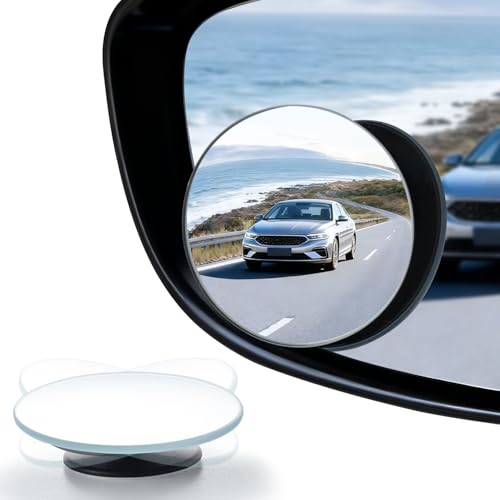
LivTee Blind Spot Mirror, 2" Round HD Glass Frameless Convex Rear View Mirrors Exterior Accessories with Wide Angle Adjustable Stick for Car SUV and Trucks, Pack of 2
【360 Degree】2 pieces packaged, newest upgrade 360 degree rotate and sway adjustable, maximize your view with wide angle…
As an affiliate, we earn on qualifying purchases.
As an affiliate, we earn on qualifying purchases.