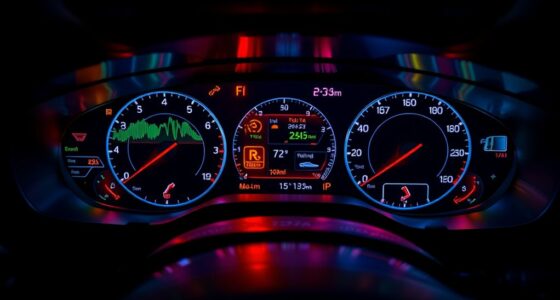
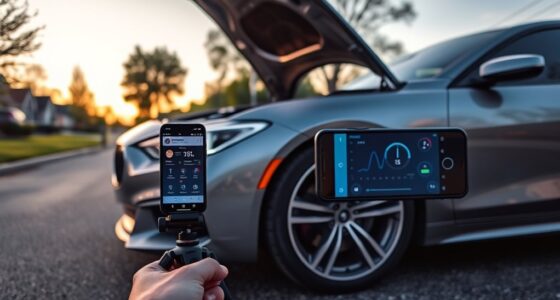
Future car diagnostics will become smarter and more proactive with OBD-III, enabling your vehicle to monitor all components in real time. It will alert you to issues early, often before you notice any problems, and even suggest maintenance automatically. AI integration will allow your car to predict failures and optimize repairs, enhancing safety and reliability. If you want to discover how these advances will transform your driving experience, there’s more to explore ahead.
Key Takeaways
- OBD-III will enable real-time, detailed diagnostic data transmission for proactive vehicle maintenance.
- AI integration will allow vehicles to predict failures and suggest or perform repairs automatically.
- Diagnostics will shift from passive alerts to active, continuous monitoring enhancing safety and reliability.
- Enhanced visual displays and communication protocols will improve driver awareness and decision-making during diagnostics.
- Future systems will support seamless updates, learning from data to optimize performance and reduce breakdowns.

Have you ever wondered how future cars will diagnose their own problems? As technology advances, vehicles are becoming smarter and more autonomous in managing their health. The next leap is the integration of autonomous vehicle diagnostics, which will enable cars to monitor every component in real time. Instead of waiting for a dashboard warning or a mechanic’s inspection, your vehicle will proactively detect issues as they arise, often before you even notice a problem. This shift isn’t just about convenience; it’s about safety, efficiency, and reducing unexpected breakdowns. AI-driven maintenance will play a central role in this evolution, allowing cars to analyze diagnostic data instantly and determine the best course of action. Imagine your vehicle’s onboard systems continuously learning from various driving conditions and operational patterns, adjusting and optimizing as needed. This level of autonomy in diagnostics means that future cars will be capable of self-repair, or at least self-recommendation for maintenance, which could greatly reduce downtime and repair costs.
The core of this innovation lies in the development of advanced communication protocols, like OBD-III, which will serve as the backbone for future diagnostics. Unlike current systems that simply store error codes, OBD-III will enable cars to transmit detailed diagnostic information in real time to manufacturers, service centers, or even directly to your smartphone. This connectivity guarantees that issues are identified early, often before they cause serious damage. Additionally, OBD-III will facilitate seamless updates to vehicle software, which means your car’s diagnostic algorithms will evolve continuously, incorporating new data and improving accuracy over time. This system will also be integrated with AI-driven maintenance platforms, allowing the vehicle to interpret complex data patterns, predict failures, and suggest preventive measures. Imagine your car alerting you about a potential brake system issue weeks before it becomes dangerous, or scheduling a maintenance appointment automatically based on predictive analytics.
With AI-driven maintenance, the entire process becomes more efficient and less reliant on human intervention. Your vehicle becomes an active participant in its own care, reducing the need for manual diagnostics and making repairs more targeted and timely. This future isn’t far off; it’s already beginning to take shape with the development of smarter onboard sensors, better data processing, and more integrated communication systems. As a driver, you’ll benefit from safer, more reliable cars that not only respond to problems but anticipate and prevent them. The era of passive vehicle diagnostics is giving way to a future where your car is a proactive partner in your journey, making driving safer, smoother, and more connected than ever before. Advances in color accuracy will further enhance the quality of the visual information displayed during diagnostics, ensuring clarity and precision in all communications.
Frequently Asked Questions
Will OBD-III Be Compatible With Existing Vehicle Models?
OBD-III isn’t fully compatible with existing vehicle models yet, but legacy compatibility is a goal for future standards. You might need retrofit options, like adapters or specialized tools, to connect your current vehicle to newer diagnostic systems. Manufacturers are working on bridging the gap, so keep an eye out for updates that could make integrating OBD-III easier, especially if your vehicle isn’t initially designed for it.
How Will OBD-III Impact Vehicle Privacy and Data Security?
OBD-III will likely increase vehicle data privacy and cybersecurity risks by collecting more detailed information. You should be aware that hackers could exploit vulnerabilities to access personal data or control systems. To protect yourself, manufacturers will need robust cybersecurity measures, but you should also stay informed about data sharing policies. Ultimately, OBD-III’s impact depends on how well security protocols are implemented to safeguard your vehicle data privacy.
What Are the Cost Implications for Consumers Adopting OBD-III?
You’ll likely face some cost concerns with adopting OBD-III, as new technology often comes with higher upfront expenses. While initial costs might be a challenge, ongoing savings from improved diagnostics and maintenance can offset this over time. However, affordability challenges could make it harder for some consumers to access the latest features. It’s wise to weigh these costs against long-term benefits before deciding to upgrade your vehicle’s diagnostic system.
Will OBD-III Require New Diagnostic Tools or Software Updates?
You’ll likely need new diagnostic tools or software updates to guarantee compatibility with OBD-III. While it might seem inconvenient, manufacturers will provide updates to maintain diagnostic compatibility, preventing costly replacements. Upgrading your tools or software now ensures seamless diagnostics and helps you stay ahead of future vehicle technologies. So, don’t worry—these updates are designed to make your diagnostic process smoother and more efficient, not more complicated.
How Soon Will OBD-III Technology Be Mandated by Regulators?
Regulators plan to mandate OBD-III technology within the next few years, but the exact timeline depends on addressing implementation challenges and regulatory approval. You should stay informed about the regulatory timeline, as it could vary by region and industry readiness. Manufacturers are working to overcome these hurdles, but widespread adoption might take longer than expected. Keep an eye on official updates to know when OBD-III becomes standard for diagnostics.
Conclusion
As you look ahead, the evolution of car diagnostics promises game-changing technology that could transform how you maintain your vehicle. With OBD-III on the horizon, the details remain shrouded in mystery—what new features will emerge? Will it make troubleshooting easier or introduce unexpected challenges? One thing’s certain: the future of automotive diagnostics is approaching fast, and staying informed could be your best move yet. Are you ready to see what’s next?