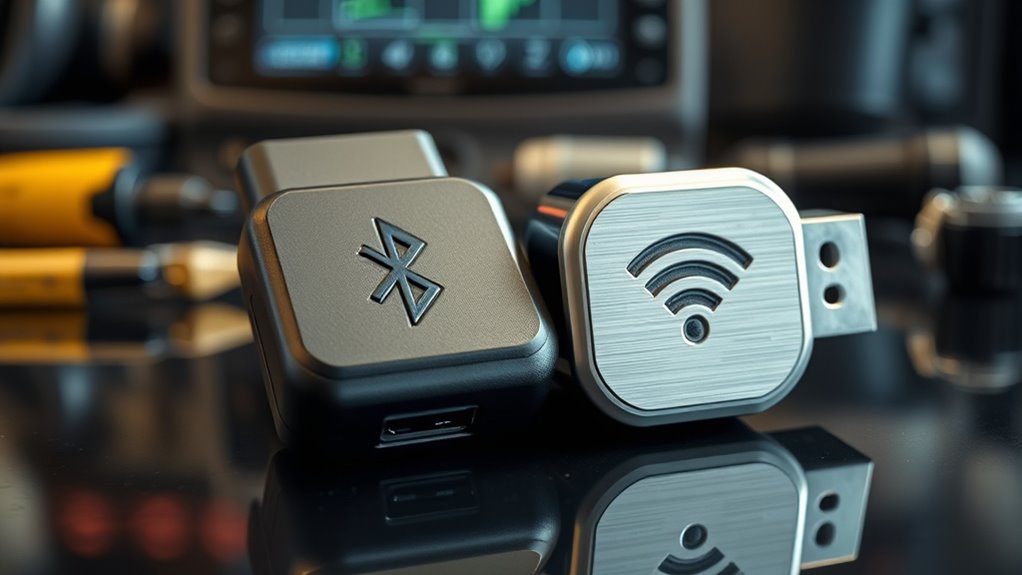

If you’re choosing between Bluetooth and Wi-Fi OBD adapters for DIY diagnostics, consider your needs. Bluetooth offers quick, reliable connections, ideal for routine checks, with good security. Wi-Fi provides faster data transfer, perfect for large data uploads, but may require more security precautions. Your vehicle compatibility and how you plan to use the tool matter too. To make the best choice and explore detailed benefits, keep going for more insights.
Key Takeaways
- Bluetooth adapters are easy to set up, quick to connect, and ideal for regular, quick diagnostics.
- Wi-Fi adapters offer faster data transfer, suitable for extensive diagnostics and large data uploads.
- Bluetooth provides better security with encrypted pairing, while Wi-Fi requires strong passwords to prevent hacking.
- Bluetooth has limited range (~10 meters), whereas Wi-Fi can connect over longer distances if network coverage is available.
- Choose Bluetooth for simplicity and security; opt for Wi-Fi when speed and detailed data transfer are priorities.

When choosing an OBD adapter for your vehicle, understanding the differences between Bluetooth and Wi-Fi options is essential. Your first consideration should be vehicle compatibility, as not all adapters work seamlessly with every make and model. Bluetooth adapters are widely compatible with many vehicles, especially older models, because they use standard Bluetooth protocols supported by most smartphones and tablets. Wi-Fi adapters, on the other hand, often require specific app support or firmware, which might limit compatibility with some vehicle systems. Before purchasing, verify whether your vehicle’s OBD-II port and onboard diagnostics are compatible with the adapter you’re considering. This step helps prevent issues during setup and ensures smooth data retrieval.
Data security is another key aspect when choosing between Bluetooth and Wi-Fi OBD adapters. Bluetooth connections generally offer a good level of security because they use pairing processes that encrypt data during transmission. This makes Bluetooth a safer choice if you’re concerned about potential hacking or data interception, especially if you’re using the adapter in public or shared environments. Wi-Fi adapters, however, can be more vulnerable if not properly secured. Since Wi-Fi networks are more exposed and often require password protection, there’s a higher risk of unauthorized access if the network isn’t secured correctly. When using a Wi-Fi adapter, make sure to change default passwords and use secure networks to protect your vehicle data. Additionally, wireless connection security is an important consideration to ensure your diagnostics data remains protected.
Bluetooth offers better security through encrypted pairing, while Wi-Fi networks require proper protection to prevent unauthorized access.
Another factor to keep in mind is how each connection type impacts your user experience. Bluetooth adapters tend to connect quickly and are simple to pair with your smartphone or tablet, making them ideal for quick diagnostics and regular checks. Wi-Fi adapters might take longer to connect but often offer faster data transfer speeds. If you’re planning to run extensive diagnostics or need to upload large amounts of data, Wi-Fi might be more suitable. However, Wi-Fi connections can sometimes be less stable, especially if your network signal is weak or congested. Bluetooth connections are generally more stable for mobile diagnostics, but they have limited range, usually around 10 meters, which means you need to stay close to your vehicle. Ultimately, your choice depends on your specific needs, vehicle compatibility, and comfort with data security. Bluetooth adapters are more straightforward, widely compatible, and secure for everyday DIY diagnostics. Wi-Fi adapters offer faster data transfer and potentially more features but require careful security measures. Consider how often you’ll use the device, your vehicle’s compatibility, and the environments where you’ll operate it to make the best decision.
Frequently Asked Questions
Can Both Adapters Work With All Vehicle Makes and Models?
Not all adapters work with every vehicle make and model. Your vehicle’s compatibility depends on the adapter’s supported protocols and the model’s OBD-II system. Both Bluetooth and Wi-Fi adapters have limitations; some may not support older vehicles or specific manufacturers. Always check the adapter’s compatibility list and specifications before purchasing to verify it works with your vehicle, avoiding potential adapter limitations.
Do Bluetooth and Wi-Fi Adapters Impact Vehicle Performance?
Like a gentle whisper in a quiet room, your Bluetooth or Wi-Fi adapter won’t impact your vehicle’s performance. They run quietly in the background, with minimal effect on signal stability or power consumption. You won’t notice a difference in how your car drives, as these adapters are designed to be passive tools. Focus on diagnostics instead of worrying about performance dips—your vehicle’s core functions stay unaffected.
Which Adapter Offers Faster Data Transfer Rates?
Wi-Fi adapters offer faster data transfer speeds compared to Bluetooth adapters, making them ideal for quick diagnostics. They also tend to provide more stable connections, especially over longer distances or in areas with interference. If you prioritize speedy data transfer and consistent connection stability for your DIY diagnostics, a Wi-Fi OBD adapter is the better choice. Just keep in mind that Wi-Fi adapters may be more complex to set up than Bluetooth ones.
Are There Differences in Security Between Bluetooth and Wi-Fi Adapters?
They say “trust, but verify,” and that’s especially true for security. Bluetooth adapters often use encryption standards like AES, making them fairly secure if you keep firmware updated. Wi-Fi adapters can be more vulnerable due to network vulnerabilities, especially if they lack strong encryption. Always guarantee your adapter supports current encryption standards and secure network practices to protect your diagnostics data from potential threats.
How Do Compatibility With Smartphone Apps Vary Between the Two?
You’ll find that Bluetooth adapters often offer a more straightforward app interface, making it easier for you to navigate diagnostics. They usually provide stable connections within a shorter range, ensuring your data flows smoothly. Wi-Fi adapters, on the other hand, can handle larger data transfers and might connect better with more advanced apps, but sometimes they face stability issues. Your choice depends on your app’s compatibility and how you prefer to work.
Conclusion
So, whether you choose Bluetooth or Wi-Fi, you’re about to reveal the secrets of your car faster than a superhero on a coffee binge! Bluetooth’s simplicity and speed make it feel like wielding a magic wand, while Wi-Fi’s powerhouse connection can handle any diagnostic challenge you throw at it. No matter your pick, you’re stepping into the driver’s seat of DIY mastery—your car won’t know what hit it! Get ready to diagnose like a legend!