
TL;DR

Get garage and car supplies delivered free — and shop member deals
- Fast, free delivery on millions of items
- Access to Prime Big Deal Days deals on October 6–7
- Prime Video, Amazon Music and more included
In an interview published by Charged EVs on October 1, 2026, EV expert Rustam Kocher described public Type 2 charging as widespread at large European business parks and shopping centers, while saying drivers still face fragmented apps and access problems. He also pointed to roaming cards that work across networks as a practical improvement, though the interview does not quantify charging availability or app reliability across Europe.
EV expert Rustam Kocher told Charged EVs that public Type 2 chargers are widespread at large business parks and shopping centers in Europe, but drivers can still face a patchwork of charging apps, poor connectivity and payment risks. The interview, published October 1, 2026, offers Kocher’s account of charging in Europe after four years there; it is not a region-wide survey of charger coverage or performance.
Kocher, who worked for many years on electric trucks before retiring to Europe, said Type 2 charging is common at large commercial destinations. Drivers generally need to bring their own cable, and charging is usually paid but relatively inexpensive because it is low power, he told the publication. His comments differ from the interviewer’s experience in Florida, where the interviewer said public Level 2 chargers have become rarer as DC fast-charging stations have expanded.
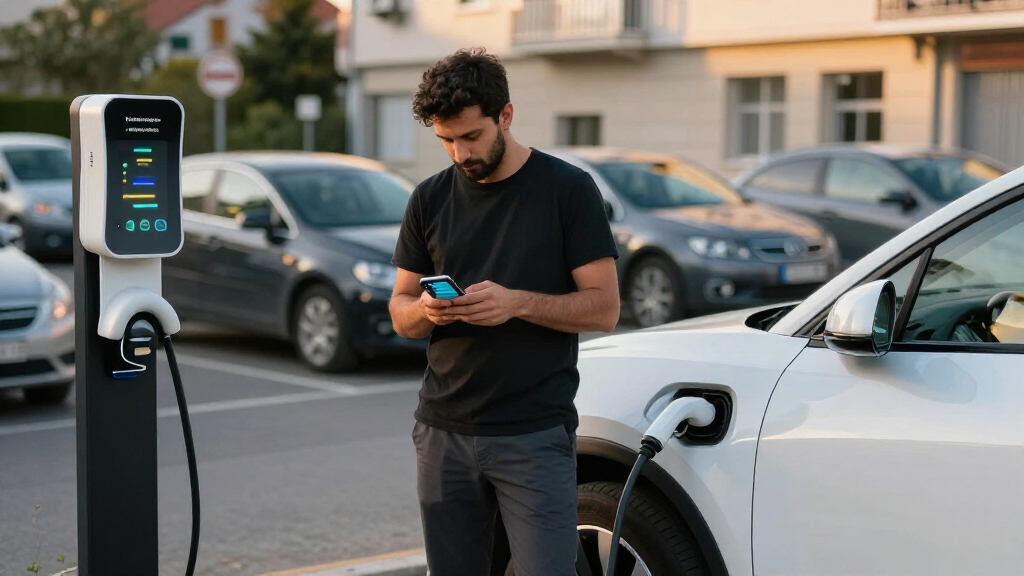
Kocher said the proliferation of operator-specific apps remains a problem in Europe, particularly in Spain. He described arriving at chargers that required downloading a new app for that site or city, and said he had about 50 charging apps on his phone. In one example, a charger in an underground parking garage had no mobile signal or Wi-Fi. He had to go upstairs to get a signal and coordinate with his wife so she could connect the cable before the charging session timed out.
He also warned that people may place counterfeit QR-code stickers over legitimate payment codes, redirecting drivers to sites that could steal their information. Kocher did not provide figures on how often this happens. As a counterpoint to the app fragmentation, he described using Octopus Energy or Chargemap cards while traveling in Spain’s Basque Country, saying partnerships let him access multiple networks with fewer separate tools.
When Available Chargers Still Fail Drivers
Kocher’s examples show why a charger being listed as available does not necessarily mean a driver can use it. Connectivity, payment access and a workable start process all affect whether a charging session succeeds. A site can appear operational while a driver without a second person, mobile signal or the required app cannot begin charging.
The interview also points to a practical distinction between expanding the charging network and making it straightforward to use. Roaming agreements and payment cards may reduce the number of accounts drivers need, while reliable alternatives to app-only access could help at sites with weak connectivity. These are implications of Kocher’s account, not measured outcomes reported by the article.
As an affiliate, we earn on qualifying purchases.
Europe’s Type 2 Charging Experience
The Charged EVs report places Kocher’s comments against a change in how public charging is viewed. Its author says early public charging rollouts often treated free Level 2 charging as a way to attract customers to retail locations, while operators expected highway DC fast charging to have thin margins. The author says operators now expect fast charging to become profitable and describes a decline in public Level 2 chargers in Florida. That Florida observation is the author’s experience, not a Europe-wide comparison.
In Europe, Kocher referred to Type 2 charging, the term used in the interview for lower-power charging at commercial destinations. He said these chargers are generally paid and require drivers to bring their own cables. On long-distance travel, he cited a trip to the Basque Country during the August eclipse as an occasion when he found more charging stations and partnership agreements than before. The interview does not specify the year of that eclipse or provide a count of stations or agreements.
The report also references a point made in 2025 by Kameale Terry, CEO of ChargerHelp: uptime alone records whether a charger is available, but not whether a driver can successfully charge on the first attempt. Terry identified first-time charge success rate as a measure closer to the driver experience. This frames Kocher’s garage example as an access problem even if the hardware itself was technically online.
“I literally have 50 apps on my phone.”
— Rustam Kocher, speaking to Charged EVs
As an affiliate, we earn on qualifying purchases.
How Broad Are These Problems?
The interview provides Kocher’s personal observations, not independently verified data on charging coverage, app quality, charger uptime or first-time charge success across Europe. It does not establish how common QR-code sticker fraud is, identify specific affected networks or say whether any information was stolen in the incident he described. The interviewer’s Florida comparison is also anecdotal.
It is not clear how many networks Kocher’s roaming cards covered, whether access was available at all stations, or how prices and terms compared across providers. The report also gives no technical or policy detail on how operators are addressing app-only access where mobile service is unavailable.
As an affiliate, we earn on qualifying purchases.
Roaming and Easier Charger Access
The report describes network partnerships and roaming as a continuing way to reduce app fragmentation, but it sets out no announced deadline or next milestone. It also notes that Octopus Charge had launched a US service intended to provide access to multiple major networks through one app and account. The interviewer said they could not complete sign-up because of problems with the app; Kocher said he hoped the company would improve it.
For drivers, the near-term practical advice implied by the account is to check payment options before a trip, carry a roaming card where available and inspect QR codes for stickers that may cover the original. Whether operators will provide consistently usable non-app payment methods, improve connectivity at charging sites or adopt first-time success measures more broadly remains to be seen.
As an affiliate, we earn on qualifying purchases.
Key Questions
What did Rustam Kocher say about public EV charging in Europe?
Kocher said Type 2 chargers are widespread at large business parks and shopping centers in Europe. He described them as generally paid, low-power chargers that require drivers to bring their own cable.
Why did Kocher criticize charging apps?
He said drivers may need separate apps for different operators or locations. In one example, poor cell reception in an underground garage made it difficult to download an app and start a charging session.
What is a charging roaming card?
It is a payment or access card that can work across participating charging networks through partnership agreements. Kocher said his Octopus Energy or Chargemap cards worked during a trip in Spain’s Basque Country, though the interview does not list every network covered.
What QR-code risk did Kocher describe?
He said people may place counterfeit QR-code stickers over legitimate charger payment codes and redirect users to fraudulent sites. The report does not give data on how frequently this occurs.
Does the interview show that European chargers are more reliable than US chargers?
No. It gives Kocher’s personal observations in Europe and the interviewer’s anecdotal experience in Florida, but offers no comparable data on reliability, coverage or successful charging rates.
Source: rss
Fall Picks
fall essentials
As an affiliate, we earn on qualifying purchases.