
TL;DR

Get business pricing on garage and car supplies
- Business-only prices and quantity discounts
- Tax-exempt purchasing
- Multiple users, one account, clear invoices
Swiss startup Winduction, an ETH Zurich spin-off, has demonstrated a system that transfers power from road-embedded coils to coils built into specially developed bus tires. The company says the system reached more than 90% transfer efficiency and is preparing test infrastructure, but route savings are still being assessed and its first pilot is planned for 2028.
Swiss startup Winduction, a spin-off from ETH Zurich, has demonstrated a system that wirelessly charges electric buses through coils integrated into specially developed tires, rather than through a receiver beneath the vehicle. The company says the system achieved more than 90% energy-transfer efficiency; its first pilot with a transport operator is planned for 2028, and projected cost savings have not yet been confirmed.
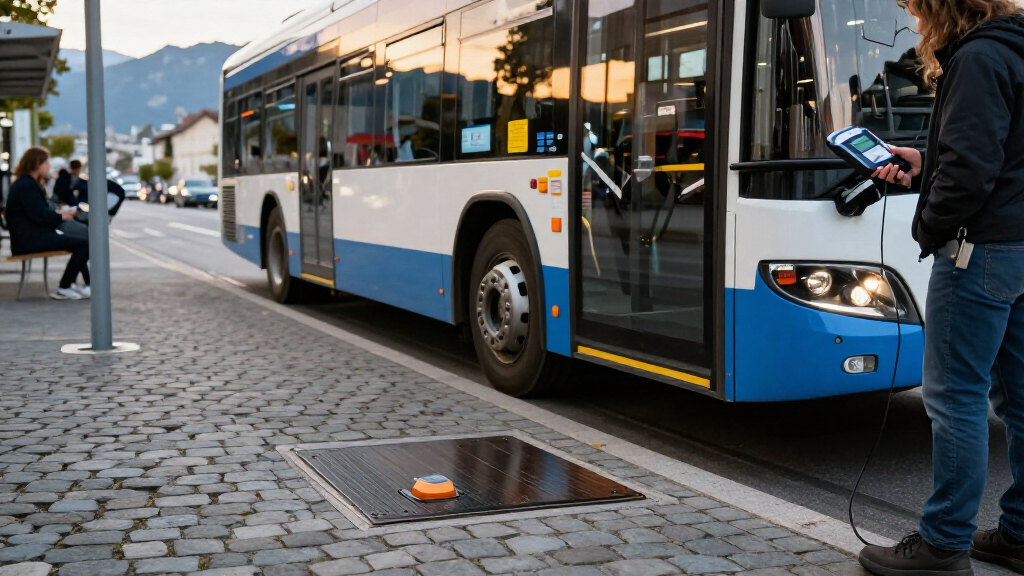
The system uses induction coils in a plate set into the road and a second set built into a purpose-developed bus tire. Winduction says locating the receiving coils inside the wheels reduces the gap between the road and the vehicle. In conventional setups, a receiver coil is mounted under the bus, where the distance from the ground can vary by vehicle and reduce transfer efficiency.
Putting coils into a bus tire required a change to its construction. According to CEO Laurin Schwitter, conventional bus tires contain steel belts that would interact with the magnetic field and turn much of the transmitted energy into heat. Winduction says it is working with partners on a steel-free tire for the system.
The company demonstrated the technology on a bus route between Zurich Airport and Oerlikon. Winduction’s calculations indicate that charging plates might be needed at two of the route’s 24 stops, with buses charging for a total of three hours over 16 hours of operation. The report compares that with the current buses’ five hours of simultaneous overnight depot charging. These are route-specific figures and proposed operating scenarios, not independently verified savings.
How Charging Could Change Bus Operations
If the system performs reliably in service, charging buses during scheduled stops could reduce the size of batteries needed for some routes. Winduction says smaller packs could lower vehicle purchase and operating costs. The approach could also allow operators to charge vehicles throughout the day rather than rely only on overnight depot charging.
For transit agencies, the practical question is whether the equipment and installation costs are outweighed by any savings in batteries, electricity infrastructure and operations. Winduction says its calculations show substantial savings compared with depot charging, but that the amount depends on the route. A feasibility study with transport operators is now measuring those potential savings; no final cost figures are provided in the report.
As an affiliate, we earn on qualifying purchases.
Why Winduction Put Coils in Tires
Most roadway inductive-charging designs described in the report send power from a coil in the road to a receiver beneath a vehicle. Winduction’s founders argue that the variable distance between those components is a drawback because energy transfer becomes less efficient as the gap increases. The tire-based design places the receiver closer to the road.
Schwitter said the company believes buses can be operated more cheaply when they are charged wirelessly and regularly during service. That is the startup’s stated case for the technology, not yet a result established through long-term commercial operation. The Zurich Airport–Oerlikon demonstration provides a route example, while Winduction’s planned facilities in Winterthur are intended to support further development and testing.
“We believe that electric buses can be operated much more cheaply if they are charged wirelessly and regularly during operation.”
— Laurin Schwitter, Winduction CEO
As an affiliate, we earn on qualifying purchases.
Costs and Durability Still Under Study
Commercial performance has not yet been established. Winduction’s reported efficiency figure is a company claim, and the source does not provide independent test results, detailed test conditions or long-term operating data. It is also unclear how the tire-integrated components will perform over time under the wear and operating conditions of bus service.
The company has not published specific installation costs, per-route savings or a comparison of total ownership costs. The route figures are based on calculations, while a feasibility study with transport operators is underway. The report does not name the operators involved in discussions or give details of a confirmed pilot partner.
As an affiliate, we earn on qualifying purchases.
Winterthur Tests and a 2028 Pilot
Winduction is building a test laboratory and test bus stop in Winterthur. The company says a later development stage will bring the system’s components together in a form designed for industry, with the aim of producing a converted electric bus that can operate outside its private test area.
The founders plan to conduct their first pilot in 2028, while discussions with several Swiss transport operators are underway. The next meaningful evidence will include results from the test infrastructure, the route feasibility study and any confirmed pilot details. Until those are available, expected savings and readiness for wider deployment remain open questions.
steel-free bus tires for wireless charging
As an affiliate, we earn on qualifying purchases.
As an affiliate, we earn on qualifying purchases.
Key Questions
How does Winduction’s wireless bus charging system work?
It transfers power from induction coils in a plate embedded in the road to receiving coils integrated into a specially developed tire. The bus charges when it is positioned over a charging plate.
Where has the system been demonstrated?
Winduction demonstrated it on a bus route between Zurich Airport and Oerlikon. The report does not describe this as a full commercial pilot.
How efficient is the system?
Winduction says energy transfer from the ground into the vehicle is above 90%. The report does not include independent measurements or detailed test conditions.
When is Winduction’s first pilot planned?
The company’s founders plan to carry out a first pilot in 2028. Discussions are underway with several Swiss transport operators, but no pilot partner is identified in the report.
Are the expected savings confirmed?
No. Winduction says its calculations show savings compared with depot charging, but the amount depends on the route. A feasibility study is currently assessing the figures, and the report provides no final cost data.
Source: rss
Halloween Picks
halloween
As an affiliate, we earn on qualifying purchases.