
For most drivers, I’d choose the NOCO GENIUS5 as the best overall car battery charger: its 5A output offers a useful balance between everyday charging time and battery maintenance. The Schumacher SC1280 is a stronger fit if faster charging matters, while the Schumacher SC1445 suits garage owners who want a wheeled unit with engine-start capability. The main tradeoffs are charging speed versus size, and a simple maintainer versus a heavier charger that can also help start a vehicle. Read on for the full breakdown of all 13 options and guidance on matching charger output and features to your battery and routine.

Get business pricing on garage and car supplies
- Business-only prices and quantity discounts
- Tax-exempt purchasing
- Multiple users, one account, clear invoices
Complete the kit


Key Takeaways
- NOCO GENIUS5 is the most balanced everyday pick: its 5A output sits between the slower GENIUS1 and GENIUS2 maintainers and higher-output garage chargers.
- NOCO’s three GENIUS models serve different routines: choose GENIUS1 or GENIUS2 for gradual charging and maintenance, and GENIUS5 when you want more charging capacity.
- Engine-start capability changes the kind of tool you’re buying: Schumacher SC1445, SC1446, SC1281, AZZUNOX, and TowerTop add starting functions, but are bulkier or more specialized than compact maintainers.
- Voltage and battery compatibility deserve a check before output: several picks support 6V and 12V batteries, while some higher-output models also list 24V use.
- Charger format matters as much as amperage: wheeled Schumacher units suit a dedicated garage space, while compact smart chargers are easier to store and leave connected for maintenance.
| NOCO GENIUS2 2A 6V/12V Smart Battery Charger and Maintainer | 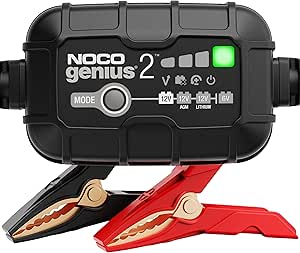 | Best for Low-Maintenance Battery Care | Output voltage: 12V | Input voltage: 12V | Current: 2A | VIEW LATEST PRICE | See Our Full Breakdown |
| Schumacher Electric SC1445 6/12V Wheeled Battery Charger and 250A Engine Starter |  | Best Manual Garage Charger and Starter | Supported voltage: 6V and 12V | Engine-start current: 250A | Boost modes: 25A and 50A | VIEW LATEST PRICE | See Our Full Breakdown |
| Schumacher Electric 10A Car Battery Charger and 200A Engine Starter SC1446 |  | Best for High-Output Manual Charging | Supported voltage: 6V and 12V | Charge current: 10A | Boost current: Up to 40A at 12V | VIEW LATEST PRICE | See Our Full Breakdown |
| 12V/24V Smart Car Battery Charger with LCD Display |  | Best for Display-Led Automatic Maintenance | Supported battery systems: 12V and 24V | Listed input voltage: 12V | Compatible battery types: AGM and gel | VIEW LATEST PRICE | See Our Full Breakdown |
| AZZUNOX 12V/24V Car Battery Charger and Maintainer, 50A, 250A Engine Starter |  | Best Multi-Function 12V/24V Pick | Output voltage: 12V or 24V | Input voltage: 110V | Maximum charging current: 50A | VIEW LATEST PRICE | See Our Full Breakdown |
| E-FAST 25A Smart 12V/24V Car Battery Charger and Maintainer |  | Best for 12V/24V Versatility | Output voltage: 12V and 24V | Input voltage: 110V | Maximum current: 25A at 12V; 15A at 24V | VIEW LATEST PRICE | See Our Full Breakdown |
| Car Battery Charger 12V 10A Smart Trickle Charger Fully Automatic |  | Best for Display-Led Charging | Output voltage: 12V DC | Input voltage: 12V | Amperage: 10A | VIEW LATEST PRICE | See Our Full Breakdown |
| NOCO GENIUS5 5A 6V/12V Smart Battery Charger and Maintainer |  | Best for Long-Term Maintenance | Output voltage: 12V; supports 6V and 12V batteries | Input voltage: 120V | Amperage: 5A | VIEW LATEST PRICE | See Our Full Breakdown |
| Schumacher Electric SC1280 15A Battery Charger and Maintainer |  | Best for Multi-Function Lead-Acid Care | Battery voltage: 6V and 12V | Maximum charging rate: 15A | 12V maintain mode: 3A | VIEW LATEST PRICE | See Our Full Breakdown |
| Craftsman 12A Car Battery Charger & Maintainer, 6V/12V (CMXCESM258) |  | Best for Mixed Battery Types | Voltage compatibility: 6V and 12V | Rapid-charge current: 12A | Maintenance current: 3A at 12V; 2A at 6V | VIEW LATEST PRICE | See Our Full Breakdown |
| Schumacher Electric SC1281 6A 6V/12V Battery Charger and Maintainer with 100A Engine Start |  | Best for Multi-Function Charging and Testing | Model: SC1281 | Battery voltage: 6V / 12V | Charging current: 2A–6A | VIEW LATEST PRICE | See Our Full Breakdown |
| NOCO GENIUS1 1A 6V/12V Smart Battery Charger and Maintainer |  | Best Compact Long-Term Maintainer | Output voltage: 12 volts | Input voltage: 120 volts | Compatible battery types: 6V and 12V lead-acid (AGM, gel, flooded, deep-cycle) and LiFePO4 | VIEW LATEST PRICE | See Our Full Breakdown |
| TowerTop 12V Smart Car Battery Charger with Engine Start |  | Best for Adjustable 12V Charging | Output voltage: 12 volts | Input voltage: 120 volts AC | Charging current settings: 2A, 10A, 25A, and AUTO | VIEW LATEST PRICE | See Our Full Breakdown |
| car battery charger | Output voltage | Input voltage |
|---|---|---|
| NOCO GENIUS2 2A 6V/12V Smart B | 12V | 12V |
| Schumacher Electric SC1445 6/1 | — | — |
| Schumacher Electric 10A Car Ba | — | — |
| 12V/24V Smart Car Battery Char | — | — |
| AZZUNOX 12V/24V Car Battery Ch | 12V or 24V | 110V |
| E-FAST 25A Smart 12V/24V Car B | 12V and 24V | 110V |
| Car Battery Charger 12V 10A Sm | 12V DC | 12V |
| NOCO GENIUS5 5A 6V/12V Smart B | 12V; supports 6V and 12V batteries | 120V |
| Schumacher Electric SC1280 15A | — | — |
| Craftsman 12A Car Battery Char | — | — |
| Schumacher Electric SC1281 6A | — | — |
| NOCO GENIUS1 1A 6V/12V Smart B | 12 volts | 120 volts |
| TowerTop 12V Smart Car Battery | 12 volts | 120 volts AC |
More Details on Our Top Picks
NOCO GENIUS2 2A 6V/12V Smart Battery Charger and Maintainer
The NOCO GENIUS2 is the right fit when the job is preserving a battery, not quickly restoring a large one. Its 2A output is modest beside the Schumacher SC1446’s 10A charging mode, so charging can take longer; in return, it offers automatic maintenance and pulse desulfation for batteries that sit between drives. Compatibility with 6V and 12V lead-acid and LiFePO4 batteries gives it a broader chemistry range than the AGM-and-gel-only helloleiboo CSC-1. Temperature sensing adjusts charging to ambient conditions, while Force Mode can address a deeply discharged battery down to zero volts. The tradeoff is capacity: its listed maximum is 40Ah, making it a poor match for large batteries or anyone expecting a fast turnaround. I’d choose it for steady upkeep and broad compatibility, not emergency starting.
Pros:- Works with both lead-acid and LiFePO4 batteries
- Temperature compensation adjusts charging to ambient conditions
- Force Mode can charge batteries discharged to zero volts
- Supports long-term maintenance and pulse desulfation
Cons:- 2A output makes charging larger batteries slow
- Listed maximum battery capacity is 40Ah
- No engine-start or boost function
Best for: Owners maintaining smaller 6V or 12V lead-acid or LiFePO4 batteries in seasonal vehicles, motorcycles, or equipment
Not ideal for: Drivers who need fast charging for large batteries or an engine-start function; its 2A output and 40Ah capacity limit make those jobs a better fit for a higher-output charger
- Output voltage:12V
- Input voltage:12V
- Current:2A
- Battery compatibility:6V and 12V lead-acid and LiFePO4
- Maximum battery capacity:40Ah
- Listed charge time:10 hours
- Cable lengths:72in AC cable; 80in DC cable
- Warranty:3 years
Our verdict“Choose the GENIUS2 for smart upkeep of smaller batteries across multiple chemistries, but pick a higher-output charger for faster recovery.”
Schumacher Electric SC1445 6/12V Wheeled Battery Charger and 250A Engine Starter
The Schumacher SC1445 is built for a garage where an operator can supervise charging and may need a strong starting assist. Its 250A engine-start mode gives it a clear advantage over the SC1446’s 200A start rating, while 25A and 50A boost modes offer more intervention than the SC1446’s listed 40A boost. The SC1445’s regular charge mode is 10A, however, and it lacks the automatic maintenance approach of the NOCO GENIUS2 or the seven-stage charging described for the AZZUNOX. Its manual timer and analog ammeter put control in the user’s hands, which suits experienced DIY mechanics but requires attention rather than unattended charging. A steel case, wheels, and retractable handle help move it around a workspace; this is still a substantial garage tool, not a compact charger to keep in a vehicle.
Pros:- 250A engine-start mode for starting assistance
- 25A and 50A boost modes alongside a 10A charge mode
- Supports 6V and 12V standard, AGM, gel, and deep-cycle batteries
- Wheels and retractable handle aid movement around a garage
Cons:- Manual timer requires the user to monitor charging
- Wheeled steel construction is bulky compared with compact smart chargers
- No automatic maintenance mode is specified
Best for: Garage owners and experienced DIY mechanics who want a wheeled charger with boost modes and a high-current starting assist
Not ideal for: Drivers seeking unattended battery maintenance, a compact roadside charger, or automatic multi-stage charging
- Supported voltage:6V and 12V
- Engine-start current:250A
- Boost modes:25A and 50A
- Charge mode:10A
- Battery compatibility:Standard, AGM, gel, and deep-cycle
- Timer:Up to 135 minutes
- Display:Analog ammeter
- Construction:Heavy-duty steel case with wheels and retractable handle
- Power cord:6ft
Our verdict“Pick the SC1445 for supervised garage charging and stronger starting assistance; choose a smart maintainer for hands-off care.”
Schumacher Electric 10A Car Battery Charger and 200A Engine Starter SC1446
The Schumacher SC1446 suits buyers who want a manual garage charger with substantial boost output, but do not need the SC1445’s higher starting rating. It provides up to 40A boost and a 200A engine start, compared with the SC1445’s 50A boost and 250A start; that makes the SC1445 the stronger choice when maximum starting assistance is the priority. The SC1446 still covers 6V and 12V standard, AGM, gel, and deep-cycle batteries, with a 10A charge mode for routine charging. A 135-minute timer lets the operator set a charging period, but it does not replace an automatic shutoff or smart multi-stage system like the AZZUNOX’s stated seven-stage charging. Its steel case and wheels favor garage mobility, though the unit is bulkier than the NOCO GENIUS2 and requires active supervision.
Pros:- 40A boost and 200A engine-start modes
- 10A charging for standard charging tasks
- Compatible with 6V and 12V standard, AGM, gel, and deep-cycle batteries
- Wheels and retractable handle make a heavy garage unit easier to move
Cons:- Manual timer means charging needs user monitoring
- Bulky steel construction is less convenient to store than a compact maintainer
- Lacks specified automatic multi-stage charging and temperature compensation
Best for: Serious DIY mechanics who need a wheeled 6V/12V charger with high boost output for automotive, marine, or powersport batteries
Not ideal for: Owners wanting automatic charging, unattended maintenance, or the highest engine-start output among these two Schumacher units
- Supported voltage:6V and 12V
- Charge current:10A
- Boost current:Up to 40A at 12V
- Engine-start current:200A
- Battery compatibility:Standard, AGM, gel, and deep-cycle
- Timer:Up to 135 minutes
- Cable length:6ft
- Power cord length:6ft
Our verdict“Choose the SC1446 for supervised, high-output garage charging, but move up to the SC1445 if stronger starting and boost ratings matter more.”
12V/24V Smart Car Battery Charger with LCD Display
The helloleiboo CSC-1 is aimed at buyers who want charging status on a screen and automatic maintenance without operating a manual timer. Its LCD display shows voltage and charging progress, and the charger is described as switching to trickle maintenance once charging is complete. That is simpler for routine upkeep than the manual Schumacher SC1445 and SC1446, which require the operator to control charging. It also lists support for 12V and 24V vehicle systems, a wider voltage range than the 12V-only NOCO GENIUS2. The tradeoffs are limited battery chemistry support—AGM and gel only—and no listed current or capacity, so buyers cannot gauge charging speed from the supplied specs. The product data also lists a 12V input despite 24V battery support; I would verify that detail before choosing it for a 24V setup.
Pros:- LCD reports voltage and charging status
- Automatic charging changes to trickle maintenance when charged
- Described as supporting 12V and 24V vehicle systems
- Temperature compensation and multiple listed electrical protections
Cons:- Not compatible with LiFePO4 batteries
- No charging current or maximum battery capacity is provided
- Listed 12V input specification conflicts with stated 24V battery support
Best for: Owners of AGM or gel batteries who want an automatic charger with a visible status display for compatible vehicles
Not ideal for: LiFePO4 battery owners or shoppers who need clearly stated charging current, capacity limits, or confidence about 24V input requirements
- Supported battery systems:12V and 24V
- Listed input voltage:12V
- Compatible battery types:AGM and gel
- Display:LCD with voltage and charging status
- Charging modes:Automatic charging and trickle maintenance
- Temperature compensation:Yes
- Safety protections:Overcharge, short-circuit, reverse-polarity, overheating, and spark-resistant protection
- Compatible vehicles:Cars, trucks, SUVs, and motorcycles
- Model:CSC-1
Our verdict“Consider the CSC-1 for automatic AGM or gel upkeep with an LCD, but verify its 24V requirements and skip it for LiFePO4 batteries.”
AZZUNOX 12V/24V Car Battery Charger and Maintainer, 50A, 250A Engine Starter
The AZZUNOX combines automatic charging, maintenance, desulfation, and starting assistance in one unit, making it a more versatile choice than the charger-only NOCO GENIUS2. Its 50A maximum charging current and 250A start surge set it apart from both wheeled Schumacher models, while support for 12V and 24V lead-acid batteries suits a broader mix of vehicles and equipment. Seven-stage automatic charging and winter mode also reduce the hands-on work required by the manual SC1445 and SC1446. The compromise is chemistry and recovery limits: it is specified for lead-acid types, not LiFePO4, and it cannot charge or jump-start batteries below 1V. At 8.8lb and 11.4 × 7.5 × 5.7in, it is portable enough to move, but less compact than a small maintainer; its one-year warranty is also shorter than the NOCO’s three years.
Pros:- Combines charging, maintenance, repair, desulfation, and engine-start functions
- Supports 12V and 24V lead-acid battery systems
- Seven-stage automatic charging and winter mode reduce manual control
- 50A charging and 250A start surge provide more output than the NOCO GENIUS2
Cons:- Does not charge or jump-start batteries below 1V
- Not specified for LiFePO4 batteries
- One-year warranty is shorter than the NOCO GENIUS2’s three-year warranty
Best for: Owners of 12V or 24V lead-acid vehicles who want automatic charging, maintenance, and engine-start assistance in one unit
Not ideal for: LiFePO4 owners or drivers whose batteries may be discharged below 1V and need recovery from that state
- Output voltage:12V or 24V
- Input voltage:110V
- Maximum charging current:50A
- Engine-start surge current:250A
- Charging modes:Seven-stage automatic charging and winter mode
- Compatible batteries:AGM, GEL, wet/flooded, EFB, calcium, MF, and deep-cycle lead-acid
- Dimensions:11.4 × 7.5 × 5.7in
- Weight:8.8lb
- Warranty:1 year
Our verdict“Choose the AZZUNOX when you need an automatic 12V/24V lead-acid charger with high output and starting help, but not for LiFePO4 or sub-1V recovery.”
E-FAST 25A Smart 12V/24V Car Battery Charger and Maintainer
The E-FAST stands apart from the other chargers here by supporting both 12V and 24V batteries, making it a better fit for owners of mixed vehicle or equipment types than the 12V-only YDBAO. Its selectable current settings, up to 25A on 12V, give buyers more control over charging speed, while Auto mode simplifies routine use. Support for lead-acid and LiFePO4 batteries adds flexibility, and the 12V booster may help with a weak battery when a quick boost is needed. The tradeoff is that the booster does not work on 24V batteries, and the 16-hour repair cycle is a long wait rather than a fast fix. I’d choose it over the NOCO GENIUS5 when 24V support and higher charging current matter more than compact long-term maintenance.
Pros:- Supports 12V and 24V batteries across lead-acid and LiFePO4 chemistries
- Selectable charging currents and Auto mode suit different charging needs
- Up to 25A output on 12V can replenish batteries faster than the 5A NOCO GENIUS5
- Includes a 12V booster, seasonal temperature adjustment, and multiple electrical protections
Cons:- Booster mode is limited to 12V batteries
- Repair mode runs for 16 hours
- Its higher output and broad compatibility may be unnecessary for owners maintaining one small 12V battery
Best for: Drivers, small-fleet owners, and equipment owners who need one charger for both 12V and 24V lead-acid or LiFePO4 batteries.
Not ideal for: Anyone who needs a 24V boost-start function or expects repair mode to restore a battery quickly.
- Output voltage:12V and 24V
- Input voltage:110V
- Maximum current:25A at 12V; 15A at 24V
- Current settings:2A, 8A, 20A, 25A, and Auto
- Battery compatibility:Lead-acid (AGM, GEL, SLA, flooded, EFB) and LiFePO4
- Charging and repair:8-stage charging; 16-hour repair mode
- Booster mode:12V only, up to 200 seconds
- Dimensions and weight:8.5 x 4.9 x 7.5 inches; 3.7 pounds
- Safety and housing:Aluminum alloy housing; reverse-polarity, spark, short-circuit, and overcharge protections; UL certified
Our verdict“Choose the E-FAST if you need a flexible charger for both 12V and 24V batteries and can accept a long repair cycle.”
Car Battery Charger 12V 10A Smart Trickle Charger Fully Automatic
The YDBAO is the clearest choice here for buyers who want to monitor what a charger is doing: its LCD displays voltage, current, temperature, and seasonal mode. That makes it more informative during a charge than the Craftsman CMXCESM258, whose listed testing relies on charger indicators. At 10A, it also charges faster than the 5A NOCO GENIUS5, while supporting both lead-acid and LiFePO4 batteries. Its limits are equally clear: it handles 12V batteries only, needs AC power, and the guidance advises against leaving it unattended for more than 12 hours. Some battery types may also require manual mode selection, so the plug-and-play description does not mean every setup is fully hands-off. I’d pick it for visible charging data, not for unattended long-term maintenance or 24V use.
Pros:- LCD shows voltage, current, temperature, and seasonal mode
- 10A output charges faster than the 5A NOCO GENIUS5
- Compatible with 12V lead-acid and LiFePO4 batteries
- Includes pulse repair and multiple safety protections
Cons:- Works with 12V batteries only
- Requires AC power and is not a portable car-plug charger
- Recommended not to operate unattended for more than 12 hours, and some battery types need manual mode selection
Best for: 12V vehicle owners who want to see live charging data and need a faster charger for cars, motorcycles, boats, or similar batteries.
Not ideal for: Owners of 24V systems or buyers seeking a charger they can leave connected unattended for extended maintenance.
- Output voltage:12V DC
- Input voltage:12V
- Amperage:10A
- Battery compatibility:12V lead-acid and LiFePO4
- Display:LCD shows voltage, current, temperature, and seasonal mode
- Charging features:Automatic charging and pulse repair
- Safety:Eight-layer protection, including reverse-polarity and overheat safeguards
- Dimensions and weight:2.76 x 5.12 x 9.06 inches; 0.58 kg
- Certifications:CE, FCC, and UL
Our verdict“Pick the YDBAO if live charging information and 10A output matter more than 24V support or extended unattended maintenance.”
NOCO GENIUS5 5A 6V/12V Smart Battery Charger and Maintainer
The GENIUS5 prioritizes careful upkeep over speed. Its 6V and 12V compatibility, temperature adjustment, and support for indefinite connected maintenance make it a strong match for vehicles that sit between drives. Compared with the Schumacher SC1280, the NOCO also supports LiFePO4 batteries and can use Force Mode on batteries discharged to zero volts. The compromise is its 5A charging limit: it is less suited to quickly replenishing a drained battery than the 10A YDBAO or the 15A Schumacher. A 120Ah maximum capacity also gives buyers a defined ceiling, and the 8-hour charge-time figure may not apply to every battery or starting state. I’d favor it for maintenance and low-voltage recovery, not when fast charging is the main requirement.
Pros:- Supports 6V and 12V lead-acid batteries as well as LiFePO4
- Temperature sensing adjusts charging for ambient conditions
- Force Mode can charge batteries discharged to zero volts
- Designed for indefinite connected maintenance and includes mounting hardware
Cons:- 5A output is slower than the 10A YDBAO and 15A Schumacher SC1280
- Maximum supported battery capacity is 120Ah
- The stated 8-hour charge time may not fit every battery or starting charge level
Best for: Owners of cars, motorcycles, or seasonal vehicles with 6V or 12V batteries who want a charger for ongoing maintenance and occasional deeply discharged batteries.
Not ideal for: Drivers who need to recharge large or heavily drained batteries quickly, or whose battery capacity exceeds the stated 120Ah limit.
- Output voltage:12V; supports 6V and 12V batteries
- Input voltage:120V
- Amperage:5A
- Battery types:Lead-acid (AGM, gel, flooded, deep-cycle) and LiFePO4
- Maximum battery capacity:120Ah
- Charging modes:Standard charging and Force Mode
- Cable lengths:72-inch AC cable; 80-inch DC cable
- Included accessories:Battery clamps, eyelet terminals, and mounting hardware
- Warranty:3 years
Our verdict“Choose the GENIUS5 for long-term 6V or 12V battery maintenance and deep-discharge recovery, rather than rapid charging.”
Schumacher Electric SC1280 15A Battery Charger and Maintainer
The SC1280 combines charging, maintenance, testing, and restoration in a unit aimed at owners of conventional 6V and 12V batteries. Its 15A maximum charging rate is a step up from the NOCO GENIUS5’s 5A, making it the more practical choice when bringing a compatible battery back up matters more than slow, long-term upkeep. It covers standard, AGM, gel, and deep-cycle batteries, but unlike the GENIUS5 or Craftsman CMXCESM258, the listed compatibility does not include LiFePO4. The 3A 12V maintain mode and 2A 6V charge mode clarify its lower-current settings, though the product data gives no battery-capacity limit. I’d choose this Schumacher for broad lead-acid care, while buyers with lithium batteries should look to the Craftsman or NOCO instead.
Pros:- Works with 6V and 12V batteries
- 15A maximum charging rate exceeds the NOCO GENIUS5’s 5A output
- Combines charging, maintenance, testing, and restoration
- Includes reverse-clamp protection and six-foot power and booster cables
Cons:- Listed compatibility does not include LiFePO4
- Requires AC power
- Product data does not specify a maximum battery capacity
Best for: Owners of standard, AGM, gel, or deep-cycle 6V and 12V batteries who want charging plus maintenance and restoration functions.
Not ideal for: LiFePO4 battery owners or buyers who need a stated battery-capacity limit before choosing a charger.
- Battery voltage:6V and 12V
- Maximum charging rate:15A
- 12V maintain mode:3A
- 6V charge mode:2A
- Compatible battery types:Standard, AGM, gel, and deep-cycle
- Functions:Charges, maintains, tests, and restores
- Protection:Reverse-clamp protection
- Cord and cable lengths:6-foot power cord and 6-foot booster cables
Our verdict“Choose the SC1280 for multi-function charging and care of 6V or 12V lead-acid batteries, but skip it for LiFePO4.”
Craftsman 12A Car Battery Charger & Maintainer, 6V/12V (CMXCESM258)
The Craftsman earns its place by pairing 6V and 12V support with LiFePO4 compatibility and a 12A rapid-charge setting. That combination makes it a more versatile option for mixed battery types than the lead-acid-focused Schumacher SC1280, while its 3A 12V and 2A 6V maintenance settings also suit batteries that need ongoing care. Automatic voltage detection reduces setup decisions, and the six-foot power cord plus six-foot battery cables provide useful reach around a garage. The limitation is its testing function: although it is described as a four-in-one charger, maintainer, tester, and restorer, the product data says testing relies on charger indicators rather than a separate built-in tester. Compared with the NOCO GENIUS5, it charges faster but offers less clearly specified long-term maintenance support.
Pros:- Supports 6V and 12V batteries, including LiFePO4
- 12A rapid charging is faster than the NOCO GENIUS5’s 5A output
- Automatic voltage detection and reverse hook-up protection simplify routine charging
- Six-foot power cord and six-foot battery cables offer 12 feet of total reach
Cons:- No separate built-in battery tester; testing relies on charger indicators
- The listed maintenance currents are 3A for 12V and 2A for 6V, not the 12A rapid-charge rate
- Does not list a 24V mode
Best for: Households or garages maintaining a mix of 6V and 12V standard, AGM, deep-cycle, and LiFePO4 batteries.
Not ideal for: Buyers who want a dedicated battery-testing instrument or a charger with explicitly stated indefinite connected maintenance.
- Voltage compatibility:6V and 12V
- Rapid-charge current:12A
- Maintenance current:3A at 12V; 2A at 6V
- Supported battery types:Standard, AGM, deep-cycle, and LiFePO4 lithium
- Functions:Charging, maintenance, testing, and restoration
- Voltage control:Microprocessor control with automatic voltage detection
- Cable lengths:6-foot power cord; 6-foot battery cables each, 12-foot total reach
- Protection:Reverse hook-up protection
- Warranty:2-year limited
Our verdict“Pick the Craftsman for faster charging across mixed 6V and 12V battery chemistries, but choose another tool if independent battery testing is a priority.”
Schumacher Electric SC1281 6A 6V/12V Battery Charger and Maintainer with 100A Engine Start
The SC1281 is a strong fit for drivers who want more than a charger: it combines 6V/12V charging and maintenance with battery and alternator testing, desulfation, boost charging, and a 100A engine start. That breadth gives it an advantage over the simpler NOCO GENIUS1, which is more compact and better suited to slow charging and long-term maintenance than starting assistance or diagnostics. The Schumacher also supports several battery types, including 12V LiFePO4. Its tradeoff is a modest 2A–6A charging range, so it is better for routine charging and upkeep than quickly replenishing a large battery. The boost and engine-start features add versatility, but may be unnecessary if you only need a maintainer for a vehicle that sits unused.
Pros:- Handles both 6V and 12V batteries, including AGM, deep-cycle, and 12V LiFePO4
- Combines charging and maintenance with battery and alternator testing
- Offers boost charging and 100A engine-start support
- Automatic shutoff and reverse-polarity protection add safeguards
Cons:- The 2A–6A charging range is slower for larger batteries than higher-output chargers
- Engine-start and boost features may be unnecessary for basic battery maintenance
Best for: Drivers and home mechanics who maintain both 6V and 12V batteries and want charging, battery checks, and emergency starting support in one unit.
Not ideal for: Buyers who mainly need a compact, low-output maintainer or want faster routine charging; its 2A–6A charging range is modest, and its start and boost functions may go unused.
- Model:SC1281
- Battery voltage:6V / 12V
- Charging current:2A–6A
- Boost charging current:12A–30A
- Engine-start current:100A
- Supported battery types:Standard, AGM, deep-cycle, and 12V LiFePO4
- Functions:Charging, maintaining, testing, and restoring
- Safety features:Reverse-polarity protection and automatic shutoff
Our verdict“Choose the SC1281 if you want one charger for battery upkeep, testing, and occasional starting help across 6V and 12V batteries.”
NOCO GENIUS1 1A 6V/12V Smart Battery Charger and Maintainer
The NOCO GENIUS1 prioritizes gentle upkeep over speed: its 1A output suits smaller batteries and vehicles stored between drives, while temperature adjustment helps tailor charging to ambient conditions. It supports 6V and 12V lead-acid batteries as well as LiFePO4, and Force Mode can charge batteries down to zero volts. Compared with the more feature-packed Schumacher SC1281, the GENIUS1 gives up testing, boost charging, and engine-start capability for a simpler, compact maintenance role. Its listed capacity limit of up to 30 amp-hours and slow output make it a poor match for quickly charging larger car batteries. The included clamps and eyelet terminals offer flexible connection options, but buyers seeking a general-purpose garage charger should look to a higher-output model.
Pros:- Supports 6V and 12V lead-acid batteries and LiFePO4
- Temperature adjustment adapts charging to ambient conditions
- Force Mode can charge batteries down to zero volts
- Includes battery clamps and integrated eyelet terminals
Cons:- 1A output makes charging larger batteries slow
- The stated battery capacity limit is up to 30 amp-hours
- Does not provide the testing, boost, or engine-start functions found on the SC1281
Best for: Owners of motorcycles, small vehicles, or stored cars who need a compact charger for slow charging and indefinite maintenance.
Not ideal for: Drivers who need to recharge a large car battery quickly, regularly recover dead batteries, or want engine-start assistance; 1A output and the stated 30Ah capacity limit narrow its use.
- Output voltage:12 volts
- Input voltage:120 volts
- Compatible battery types:6V and 12V lead-acid (AGM, gel, flooded, deep-cycle) and LiFePO4
- Battery capacity:Up to 30 amp-hours
- Charging modes:Standard charging and Force Mode
- DC cable length:110 inches
- Included accessories:Battery clamps and integrated eyelet terminals
- Warranty:3 years
Our verdict“Pick the GENIUS1 for low-current maintenance of smaller or stored batteries, not for fast charging or emergency starting.”
TowerTop 12V Smart Car Battery Charger with Engine Start
The TowerTop is the better match for buyers who want to choose charging speed: its settings range from 2A to 25A, with an automatic option, eight-stage charging, and an LCD that displays charging stages and parameters. That higher ceiling can make routine charging more practical than the NOCO GENIUS1, whose 1A output favors maintenance over speed. TowerTop also adds winter, repair, and maintenance modes, plus a 100A engine-start function. The tradeoff is narrower voltage coverage: unlike the 6V/12V Schumacher SC1281, this is a 12V-only unit for lead-acid battery types. Its description also says it cannot repair completely drained batteries, so repair mode should not be treated as a cure for every dead battery. This is a feature-rich choice for 12V owners, not a universal battery solution.
Pros:- Selectable 2A, 10A, 25A, and automatic charging modes
- Eight-stage charging with LCD status and parameter display
- Includes winter, repair, and maintenance modes
- Provides 100A engine-start support and several listed safety protections
Cons:- Supports 12V lead-acid batteries only, unlike the 6V/12V SC1281
- Cannot repair completely drained batteries
- More modes and settings may be unnecessary for buyers who only need a basic maintainer
Best for: 12V car owners who want selectable charging rates, an LCD readout, seasonal charging modes, and occasional engine-start assistance.
Not ideal for: Owners of 6V batteries or LiFePO4 batteries, and anyone relying on a charger to recover a completely drained battery.
- Output voltage:12 volts
- Input voltage:120 volts AC
- Charging current settings:2A, 10A, 25A, and AUTO
- Maximum charging current:25A
- Engine-start current:100A
- Battery compatibility:STD, AGM, GEL, Wet, MF, EFB, calcium, and deep-cycle lead-acid
- Charging stages:8
- Dimensions:7.68 x 10.04 x 4.92 inches
- Certifications:BC, ETL, FCC
Our verdict“Choose TowerTop if you want adjustable, higher-output charging and engine-start help for 12V lead-acid batteries, but skip it for 6V or LiFePO4 use.”

How We Picked
I compared these car battery chargers by the jobs they are built to handle: routine battery maintenance, charging a depleted battery, and helping start a vehicle. I weighed charging output against practical fit, since a higher-amp charger can save time but may be larger and less convenient for a driver who mainly wants seasonal maintenance. I also looked at supported voltage, smart charging and maintenance functions, and whether a model adds features such as an engine starter or wheeled construction.
The ranking favors useful versatility without unnecessary bulk. The NOCO GENIUS5 leads as a balanced choice for common 6V/12V charging and maintenance; faster or starter-equipped models rank higher for specific garage needs, not as universal upgrades. Lower-output NOCO options remain compelling for slower, compact maintenance, while models with 24V support or high-output starting functions are placed for buyers who can use those capabilities. Where product names provide limited detail, I avoid assuming protections or functions that are not specified.
Factors to Consider When Choosing Car Battery Chargers
Before choosing, I’d match the charger to the battery and the way you plan to use it. A charger for keeping a healthy battery topped up is a different purchase from one meant to charge a deeply depleted battery or assist with starting. These broader checks can prevent paying for unused output—or choosing a unit that cannot serve your vehicle.
Match Charger Voltage to the Battery
Check the voltage printed on the battery or listed in the vehicle manual before connecting a charger. Many passenger vehicles use 12V batteries, but this roundup also includes chargers that list 6V or 24V support. A multi-voltage label does not mean every setting suits every battery, so select the correct mode rather than relying on the charger to guess. If you maintain more than one vehicle or equipment type, broader voltage support can be useful; for a single car, it may add complexity without much benefit. When the battery type is unclear, confirm compatibility in the charger instructions before purchase.
Choose Output for Your Charging Routine
Amperage affects how quickly a charger can replenish a battery, but a bigger number is not automatically a better fit. Low-output models such as the 1A and 2A maintainers make more sense for gradual charging or long periods connected to a battery than for a quick turnaround. Midrange choices such as a 5A charger balance everyday charging with a manageable size. Higher-output units can be more practical when a battery needs charging sooner, though they may be larger and offer more capacity than a casual user needs. Think about how often you charge a battery and how much waiting time you can accept.
Separate Maintenance From Recovery and Starting
A maintainer is designed to keep a battery charged during storage; it is not the same thing as an engine starter or a remedy for a failing battery. Some picks combine charging with an engine-start function, which may help in a garage when a vehicle will not start, but that extra capability can come with a larger, less portable format. Do not treat a starter rating as a substitute for a portable jump starter unless the product is specifically designed for that role. If your main concern is winter storage, a compact smart maintainer may be the more sensible choice. If you regularly work on vehicles, a combination unit may justify the extra footprint.
Check Battery Chemistry and Charging Instructions
Voltage alone does not establish compatibility: battery chemistry and the maker’s charging guidance also matter. Review the manual for both the battery and charger to confirm that the selected mode supports the battery you own. A smart charger can simplify routine use, but buyers should still understand which mode is active and when a connection is safe. Avoid assuming that a charger labeled “smart” supports every battery chemistry or can safely charge a damaged battery. If you have a vehicle with a specialized battery, verify support before choosing by amperage or brand.
Balance Portability Against Garage Convenience
Consider where the charger will live and how often you will move it. Small maintainers are easier to store in a vehicle cabinet or on a shelf, while wheeled chargers make more sense as stationary garage equipment that can be moved around a work area. A large unit can be awkward to carry to a parked car, even if it offers stronger charging or starting functions. Cable reach, access to a suitable outlet, and space around the battery also affect day-to-day usability. Pick the format that fits your storage and charging location rather than buying capacity you cannot conveniently use.
Pay for Features You Will Use
Extra modes, voltage options, and engine-start functions can be valuable when they match a real task, but each adds another decision at setup. A driver maintaining one 12V car may be better served by a straightforward smart charger than a multi-voltage, high-output garage unit. Conversely, a household with several vehicles or a workshop may benefit from wider compatibility and faster charging. Compare the charger’s stated functions with your actual batteries and routine instead of treating feature count as a quality measure. The best fit is the model that handles your common job without leaving you unsure which setting to use.
Frequently Asked Questions
Is a 1A or 2A charger enough for my car battery?
It can be enough if your main goal is to maintain a battery or recharge it gradually, especially when you can leave it connected for an extended period. The NOCO GENIUS1 and GENIUS2 are lower-output options in this lineup, so they are less suited to buyers who want the quickest turnaround. A 5A or higher charger may be a better match when you regularly need to replenish a depleted battery sooner. Check the battery maker’s guidance and the charger’s supported battery types before use. Do not choose a low-output maintainer to solve a battery that repeatedly fails to hold charge.
Should I buy a charger with an engine-start function?
Choose an engine-start model if you expect to use that function in a garage and are comfortable with a larger, more specialized unit. Picks such as the Schumacher SC1445 and SC1446 combine charging with starting capability, unlike the compact NOCO GENIUS maintainers. That extra function does not make the charger a substitute for diagnosing a weak battery or a separate jump starter intended for portable roadside use. If your routine is seasonal storage or slow maintenance, a simpler charger may be easier to store and operate. Read the product instructions for the exact starting procedure and limits.
Can one charger handle both 12V and 24V batteries?
Some chargers in this roundup list 12V/24V support, including the E-FAST and AZZUNOX models, while several others focus on 6V/12V batteries. Multi-voltage support is useful for a garage with different vehicle or equipment batteries, but it does not make a charger suitable for every battery chemistry or capacity. Confirm that the specific model supports the battery you intend to charge and follow its mode-selection instructions. Never connect a charger using a voltage setting based only on the vehicle’s appearance or size. If you own only a standard 12V car, 24V capability may not provide a practical advantage.
Can I leave a smart charger connected while my car is in storage?
Some chargers in this selection are described as maintainers, including the NOCO GENIUS models, making them candidates for storage use. Still, confirm the product manual permits the intended connection length and that the battery type is supported. Set up the charger in a dry, suitable location with the cables arranged away from moving or hot parts, following the manufacturer’s safety instructions. A maintainer can help keep a serviceable battery charged, but it cannot repair a battery that is damaged or no longer holds charge. For long storage, also check the vehicle manual for any battery-disconnection guidance.
When is a wheeled charger a better choice than a compact model?
A wheeled charger is a better fit when it will stay in a garage and you value higher-output charging or engine-start capability more than easy carrying. The Schumacher SC1445 is the clearest garage-oriented example here, while the smaller NOCO maintainers are easier to store and move. Wheeled units can be inconvenient if you need to carry a charger to a vehicle parked away from the garage or keep equipment in a small space. Check the charger’s dimensions, power requirements, and cable reach against your setup. Choose compactness for portability and a wheeled format for a fixed work area.
Conclusion
For most owners, I’d pick the NOCO GENIUS5 as the best overall because its 5A output and 6V/12V support balance everyday charging with maintenance. The Craftsman 12A is my best value-style choice for buyers who want more output than a basic maintainer, while the Schumacher SC1445 is the best premium-style garage pick for those who can use its wheeled format and engine-start function. Beginners who want a compact, straightforward maintenance option should look at the NOCO GENIUS2; choose the GENIUS1 only if slower charging suits your routine. For specific needs, the E-FAST 25A or AZZUNOX 12V/24V better match buyers seeking higher output and broader voltage support, while the SC1446, SC1281, and TowerTop offer alternatives with starting features. Match the charger to your battery voltage, charging schedule, and available storage space before deciding.